

China Crypto Risk Assessment
Assess your risk level based on current Bitcoin activities under China's complete crypto ban. This tool analyzes potential legal consequences based on your actions.
China doesn’t just regulate cryptocurrency-it bans it. Completely. Since 2021, every form of crypto trading, mining, and exchange service has been illegal on Chinese soil. For Bitcoin holders, this isn’t just a policy shift. It’s a legal minefield.
What Exactly Is Banned?
China’s crypto ban isn’t a single law. It’s a web of rules that shut down every possible way to interact with Bitcoin legally. Financial institutions-banks, payment processors, even fintech apps-are forbidden from handling any crypto transactions. That means no buying, selling, depositing, or withdrawing Bitcoin through Chinese banks. Not even as a side feature. Exchanges? Banned. Whether they’re based in Shanghai or Singapore, if they let Chinese residents trade, they’re breaking the law. The government has forced major platforms like Huobi and OKX to shut down their domestic operations and move offshore. Even offering crypto-related financial products-like staking or lending-is illegal. Mining? Also banned. In 2021, the government ordered all Bitcoin mining operations to shut down, calling them energy hogs with no economic value. Thousands of mining rigs across Sichuan, Inner Mongolia, and Xinjiang were unplugged. Some operators got a few months to wind down. Others had their equipment seized. Today, there’s virtually no legal mining left in China. Internet companies have to block crypto content. If you search for "how to buy Bitcoin" on Baidu or WeChat, you’ll get nothing. Ads for crypto wallets? Blocked. Telegram groups promoting crypto? Shut down. The government uses AI to scan for keywords and automatically delete posts.But People Are Still Trading
Here’s the contradiction: despite the ban, Bitcoin trading is still common in China. How? Because enforcement is messy. Many Chinese users turn to peer-to-peer (P2P) platforms like LocalBitcoins or Paxful. They pay in cash, bank transfers, or even gift cards. Others use overseas exchanges with fake IDs or VPNs. Some even trade through trusted friends using WeChat or QQ. The People’s Bank of China admits these activities are widespread, but says enforcement is difficult because the transactions are decentralized and hidden. The problem? If you get caught, there’s no legal protection. If someone scams you on a P2P trade, you can’t go to court. The government won’t recognize your Bitcoin as property. No refunds. No lawsuits. Just silence.What Happens If You’re Caught?
There’s no public record of people going to jail for holding Bitcoin. But that doesn’t mean there’s no risk. The Ministry of Public Security treats crypto as a top money laundering tool. If you transfer large sums from crypto to your bank account, you’ll trigger an AML alert. Banks are required to investigate. They might freeze your account. They might ask for proof of where the money came from. If you can’t prove it’s from a legal source-like salary or real estate-you could face fines or even criminal charges for "illicit fund transfers." Some people have lost their bank accounts entirely after being flagged for crypto activity. Others report being denied loans or mortgages because their financial history shows "unexplained digital asset inflows." The message is clear: don’t bring Bitcoin into the traditional banking system. Keep it separate. Or don’t touch it at all.
China’s Real Goal: The Digital Yuan
China isn’t banning crypto because it hates technology. It’s banning it because it wants to control digital money itself. The People’s Bank of China has been developing the Digital Yuan-its own central bank digital currency (CBDC)-for years. Unlike Bitcoin, the Digital Yuan is fully traceable. The government can see every transaction, freeze accounts remotely, and even set expiration dates on digital cash. This isn’t just about money. It’s about power. By replacing cash and private digital payments with state-controlled digital currency, China eliminates financial anonymity. It stops capital flight. It prevents people from using Bitcoin to bypass sanctions or hide wealth. Bitcoin’s decentralized nature is the threat. No government can track it. No central authority can shut it down. That’s why China won’t allow it-even if millions still use it in secret.Can China Change Its Mind?
Rumors fly every year. "China is lifting the ban!" "Bitcoin is coming back!" These usually start on Telegram or get amplified by influencers on X (formerly Twitter). In 2025, a fake news story about a new crypto license program went viral-thanks to accounts like FirstSquawk and Unusual Whales. It was false. The government didn’t issue a single new permit. There’s no sign China is softening. The 2024 PBOC notice reinforced that cryptocurrencies are not legal tender. The National Development and Reform Commission still lists crypto mining as a "high-risk, low-efficiency" industry. The CBDC rollout continues to expand across 26 provinces. Some analysts think China might one day allow crypto trading on licensed, government-monitored exchanges-like how it handles stocks. But that’s unlikely. Why create a system where people can bypass the Digital Yuan? The goal isn’t to coexist with Bitcoin. It’s to replace it.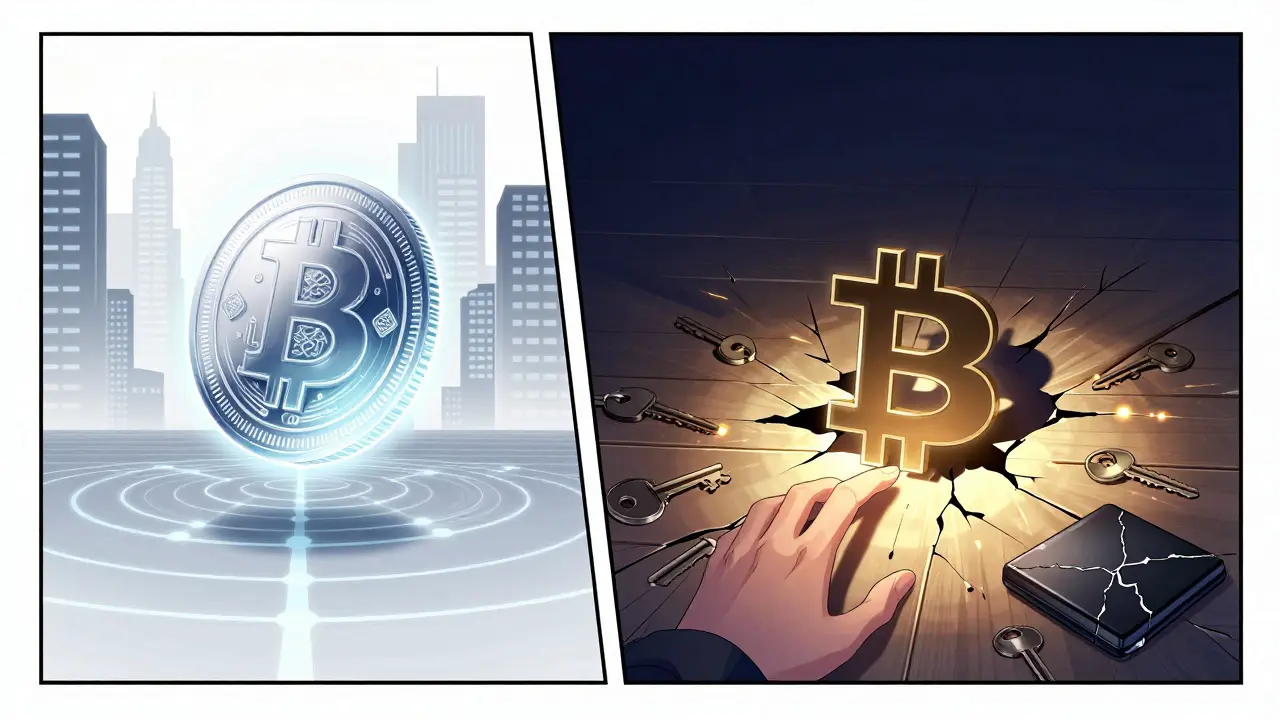
What Should Bitcoin Holders Do?
If you’re a Chinese citizen holding Bitcoin:- Don’t try to cash out through Chinese banks. You’ll get flagged. Your account could be frozen.
- Don’t use local exchanges. They’re illegal. And they’re often scams.
- Use overseas wallets. Keep your private keys safe. Use hardware wallets like Ledger or Trezor.
- Never link your real identity to crypto. Use pseudonyms. Avoid KYC on P2P platforms if possible.
- Understand the legal risk. Holding Bitcoin isn’t illegal-but moving it into the banking system is.
- Don’t market crypto services to Chinese users. Even if you’re based in New Zealand or the U.S., serving Chinese residents violates Chinese law.
- Be aware of compliance risks. Your bank might flag transactions from Chinese IPs or wallets.
- Prepare for volatility. Any rumor about China changing policy can spike Bitcoin prices overnight-then crash them just as fast.
Why This Matters Globally
China’s ban isn’t just a local issue. It’s a global shockwave. Before the 2021 crackdown, China controlled over 70% of global Bitcoin mining. When it shut down, the hash rate dropped by half overnight. Prices plunged. Miners fled to the U.S., Kazakhstan, and Russia. Today, Chinese investors still hold an estimated 10-15% of all Bitcoin worldwide. They’re not gone. They’re just hidden. And if China ever relaxes its rules-even slightly-those holdings could flood the market. Or worse, they could trigger a massive buying surge. No one knows what will happen. But one thing is certain: China’s stance on Bitcoin is one of the biggest wild cards in crypto. And it’s not going away anytime soon.What’s Next?
The Digital Yuan will keep expanding. More cities, more users, more control. Bitcoin will keep being traded in the shadows. The gap between law and reality will widen. For Bitcoin holders, the lesson is simple: don’t trust the system. Don’t rely on the government. Keep your keys safe. Stay off the radar. And understand that in China, owning Bitcoin doesn’t mean you own anything you can protect.Is it illegal to own Bitcoin in China?
No, it’s not illegal to hold Bitcoin in China. But it is illegal to trade it, mine it, or use it as payment. The government doesn’t criminalize private ownership, but it makes it nearly impossible to use Bitcoin legally. If you hold it, you’re on your own-no legal recourse if you’re scammed or lose access.
Can I use a VPN to trade Bitcoin in China?
Technically, yes-but it’s risky. Using a VPN to access overseas exchanges violates Chinese internet regulations. While enforcement is inconsistent, authorities have cracked down on VPN providers and flagged users who access banned platforms. Your internet service provider might report suspicious activity. If you’re caught, you could face fines or restrictions on your online access.
What happens if I transfer Bitcoin to my Chinese bank account?
Don’t do it. Chinese banks are required to monitor all transactions for crypto links. If they detect a transfer from a crypto wallet, they’ll freeze your account and demand proof of legal source. If you can’t provide it, you may face fines, account closure, or even criminal investigation for money laundering. The bank doesn’t care if you bought Bitcoin legally overseas-they only care that it came from an illegal source under Chinese law.
Are there any legal crypto exchanges in China?
No. All domestic crypto exchanges were shut down in 2017 and 2021. Any platform claiming to be a "legal" Chinese exchange is either a scam or operating illegally. Even if it looks official, it’s not authorized by the government. The only legal digital currency in China is the Digital Yuan, issued by the People’s Bank of China.
Will China ever legalize Bitcoin?
Highly unlikely. China’s focus is on the Digital Yuan, not decentralized cryptocurrencies. The government wants control, not decentralization. Legalizing Bitcoin would undermine its digital currency project and open the door to capital flight and financial instability. While rumors of policy changes surface every year, none have ever been confirmed-and the official stance has only hardened since 2021.
Can I mine Bitcoin in China if I don’t use electricity?
No. The 2021 ban doesn’t depend on energy use-it bans mining entirely. Even if you use solar power or run a rig on batteries, it’s still illegal. The government targets the activity, not the resource. Any mining equipment, regardless of power source, is subject to seizure. Enforcement is broad: if you’re mining, you’re breaking the law.
How do Chinese citizens still access Bitcoin if it’s banned?
Most use peer-to-peer (P2P) platforms like LocalBitcoins or Paxful, trading with cash or bank transfers. Others use overseas exchanges with fake IDs or through trusted contacts. Some trade via WeChat or QQ groups. Enforcement is patchy, so while the rules are strict, the reality is that many people find ways around them-often at great personal risk.
Does China’s crypto ban affect Bitcoin’s price?
Yes, but indirectly. China’s ban caused Bitcoin’s price to drop sharply in 2021 when mining shut down. Today, the bigger impact comes from rumors. When fake news spreads about China lifting the ban, Bitcoin surges. When rumors turn out false, prices crash. Chinese investors still hold a large portion of Bitcoin globally, so any future policy shift-even a small one-could trigger major market swings.
Vidhi Kotak
December 12, 2025 AT 11:15Been watching this play out for years. China’s move isn’t about banning tech-it’s about control. Bitcoin’s anonymity is a threat to their entire digital currency project. They don’t fear crypto; they fear losing grip on money flow.
JoAnne Geigner
December 13, 2025 AT 16:23I get why people say it’s a ‘minefield’… but honestly? If you’re holding Bitcoin in China, you’re already accepting the risk. It’s like owning a vintage car in a city that just banned gasoline-technically not illegal to have it in your garage, but good luck driving it without getting fined.
Taylor Farano
December 14, 2025 AT 10:47So let me get this straight… the same government that turned its entire population into surveillance subjects is now scared of a decentralized ledger? Pathetic. If you can’t beat it, ban it. Classic authoritarian move.
Alex Warren
December 16, 2025 AT 06:12China’s ban is technically about financial sovereignty, not technology. Bitcoin’s decentralization undermines the PBOC’s ability to monitor capital flows. That’s the real threat-not the tech itself.
Kathy Wood
December 17, 2025 AT 04:29People are still trading? That’s so irresponsible!!
Sarah Luttrell
December 18, 2025 AT 21:03LOL imagine thinking Bitcoin is 'property' in a country where the state owns your phone, your car, and your thoughts. You think a ledger is gonna save you? 😂
Claire Zapanta
December 19, 2025 AT 20:33Of course they ban it. The U.S. is just as bad-just quieter. NSA monitors everything. The only difference? China’s honest about it. They don’t pretend to be 'free' while spying on you.
Kurt Chambers
December 20, 2025 AT 08:08China’s not banning bitcoin… they’re banning freedom. And guess what? The digital yuan is just the new global currency they’re forcing on everyone. Wake up, sheeple.
amar zeid
December 21, 2025 AT 01:52While the legal framework is clear, the practical reality is far more nuanced. Many Chinese citizens utilize decentralized mechanisms to preserve wealth, often through trusted networks. This reflects a deeper societal adaptation to regulatory constraints-not defiance, but resilience.
Steven Ellis
December 23, 2025 AT 01:13What’s fascinating isn’t the ban-it’s the quiet persistence. Millions of people still hold Bitcoin not because they’re tech fanatics, but because they’ve seen how fragile centralized systems can be. China’s crackdown might look ironclad, but human beings find ways to preserve autonomy-even in the most controlled environments.
Kathleen Sudborough
December 25, 2025 AT 00:58I think people underestimate how much this affects families. Imagine being a parent who bought Bitcoin as a hedge against inflation-and now can’t even explain to your kid why you can’t access it. It’s not just about money. It’s about trust in the future.
Rakesh Bhamu
December 26, 2025 AT 06:38It’s not about whether Bitcoin is legal-it’s about whether the state allows alternative systems of value. The Digital Yuan is the future they’re building. Bitcoin is the ghost they can’t erase.
Jeremy Eugene
December 27, 2025 AT 18:19For those outside China offering services to Chinese users: please understand that compliance is not optional. Even if your business is registered elsewhere, facilitating access to prohibited financial instruments under Chinese law carries significant legal exposure.
Kelly Burn
December 28, 2025 AT 04:28China’s banning crypto because they know it’s the future… and they want to own it. The Digital Yuan = state-approved blockchain. Bitcoin = free-for-all chaos. Guess which one the regime picks? 🤡
Patricia Whitaker
December 29, 2025 AT 02:17Wow, another long article about how China’s evil. Newsflash: they’re not the only ones doing this. The EU’s MiCA? The US’s SEC crackdown? Everyone’s trying to control crypto. China’s just the first to be blunt about it.
John Sebastian
December 30, 2025 AT 10:05If you’re holding Bitcoin in China, you’re gambling with your financial freedom. Don’t pretend it’s a victim story. You knew the rules. You chose the risk.