

Imagine you are trying to send money to a friend. In the old way, you hand your cash to a bank teller. They check their books, take a cut, and then tell your friend’s bank to update their ledger. It takes time, it costs money, and you have to trust that the bank didn’t make a mistake or steal from you. Now imagine sending that same value directly to your friend, verified by a network of thousands of computers around the world, with no middleman taking a cut. This is the core difference between dApps (decentralized applications) and traditional apps.
We use traditional apps every day-Facebook, Uber, Netflix. They work great because one company controls them. But that control comes with risks: data breaches, censorship, and hidden fees. dApps, built on blockchain technology, flip this model on its head. They don’t belong to anyone. They run on code that lives on a public ledger. If you are wondering whether to build or use a dApp, you need to understand exactly how they differ from the software you already know.
Who Is Really in Charge?
The biggest difference isn’t technical; it’s philosophical. Who owns the application?
With a traditional app like Instagram or Twitter, a single entity-Meta or X Corp-owns the servers, the database, and the rules. If they decide to ban your account, change the algorithm, or sell your data to advertisers, you have little recourse. You are renting access to their platform. This centralization allows for fast updates and easy customer support, but it creates a single point of failure. If the company goes bankrupt or decides to shut down the service, your history disappears.
In contrast, a dApp operates on a peer-to-peer network where no single entity has total control. Take Uniswap, a popular decentralized exchange. No CEO can pause trading if they dislike a specific token. The protocol is governed by code and, increasingly, by token holders who vote on changes. If one server goes down, the rest of the network keeps running. This resilience means the app cannot be easily censored or shut down. However, this also means there is no "customer service" number to call if you lose your password. You are your own bank, which is empowering until you forget your keys.
How Data Lives and Dies
Think about where your photos live when you upload them to Google Photos. They sit on Google’s centralized servers. Google has the master key. They can scan them for ads, share them with law enforcement, or lose them in a rare server crash. This is the standard model for almost all web services today.
dApps handle data differently. User identities are not stored in a central database with names and emails. Instead, they are represented by cryptographic wallet addresses. Your data might be stored across multiple nodes in the network or on decentralized storage solutions like IPFS (InterPlanetary File System). Because the data is distributed, it is much harder for hackers to wipe out an entire user base by attacking one server. In 2022, traditional apps suffered over 1,800 data breaches in the US alone, affecting hundreds of millions of records. While dApps aren't immune to hacks, the attack surface is different. Hackers usually target vulnerabilities in the smart contract code itself, rather than stealing a central database.
Speed, Cost, and the Gas Problem
If you want raw speed, traditional apps win hands down. A centralized server can process tens of thousands of transactions per second. When you buy something on Amazon, the transaction is confirmed instantly. This is because the decision is made locally by one powerful computer system.
dApps are slower because every transaction must be validated by many computers across the globe to ensure consensus. On Ethereum, the main blockchain for many dApps, this can mean waiting minutes for confirmation and paying "gas fees" to compensate the validators. During busy times, these fees can spike dramatically. If you want to swap $5 worth of tokens, you might pay $10 in gas fees. That doesn’t make sense. This is why Layer 2 solutions like Arbitrum or Optimism were created-they bundle transactions off-chain and post the results to the main chain, offering speeds closer to traditional apps while keeping decentralization.
| Feature | Traditional App | dApp (Decentralized) |
|---|---|---|
| Ownership | Single company/entity | Distributed network/community |
| Data Storage | Centralized servers (AWS, Azure) | Distributed nodes / Blockchain |
| Login Method | Email/Password or Social Login | Cryptographic Wallet (e.g., MetaMask) |
| Transaction Speed | Milliseconds (Very Fast) | Seconds to Minutes (Slower) |
| Fees | Hidden in subscription/service cost | Transparent gas/network fees |
| Censorship Resistance | Low (Owner can ban users) | High (Code executes automatically) |
The User Experience Barrier
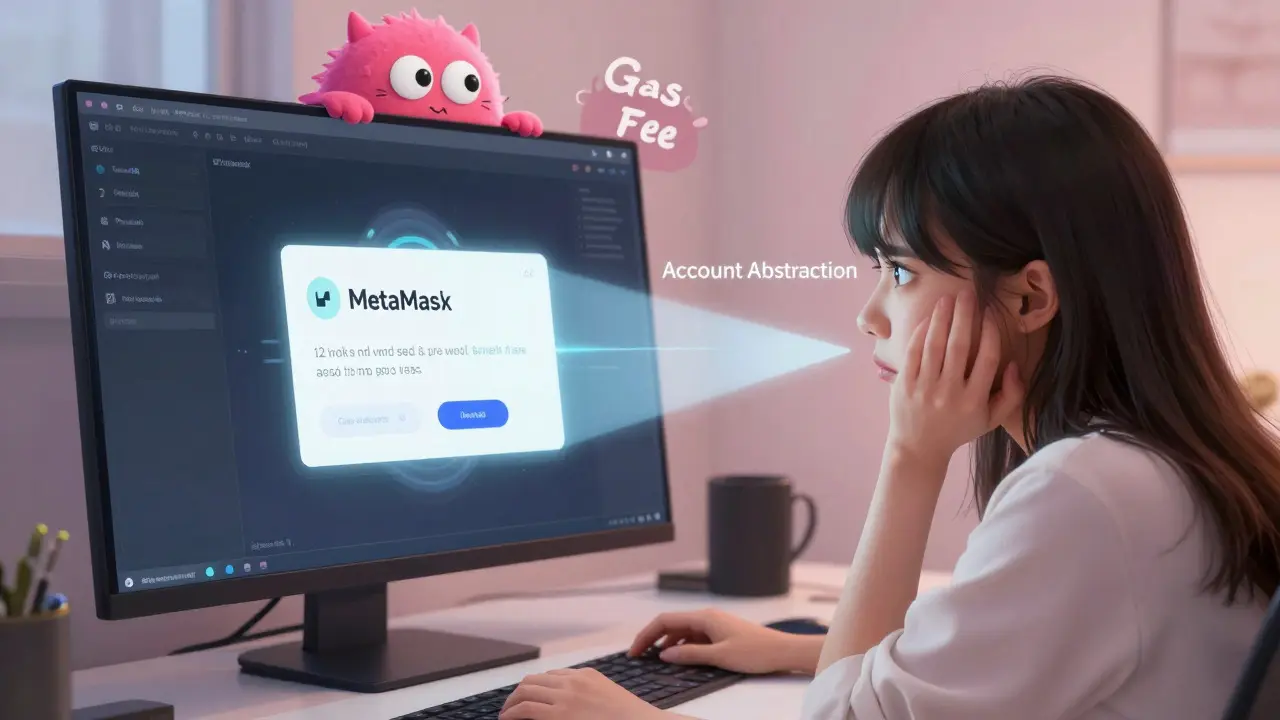
Let’s be honest: using a dApp is currently more annoying than using a traditional app. To sign up for Spotify, you enter an email and password. Done. To use a DeFi dApp, you need to install a browser extension like MetaMask, back up a 12-word seed phrase on paper, keep it safe from fire and theft, and manage private keys. If you lose those words, your funds are gone forever. There is no "Forgot Password" link.
This friction is the biggest hurdle for mass adoption. Traditional apps prioritize ease of use above all else. dApps prioritize security and sovereignty. Developers are working on "Account Abstraction" (ERC-4337) to fix this. Imagine logging into a dApp with your face ID or email, while the complex cryptography happens in the background. We are seeing early versions of this, but for now, the learning curve is steep. You need to understand what a "gas fee" is, what a "slippage tolerance" means, and how to verify contract addresses to avoid scams.
Security: Centralized Risk vs. Code Vulnerability
Both models have security issues, but they look different. With traditional apps, the risk is often human error or insider threats. An employee might leak a database, or a hacker might find a weak spot in the firewall. When Equifax was hacked, millions of people suffered because one company’s perimeter was breached.
With dApps, the security lies in the code. Once a smart contract is deployed on the blockchain, it is very hard to change. If there is a bug in the code, hackers will exploit it. In 2022, dApps lost over $1 billion due to smart contract exploits. However, because the code is open-source, anyone can audit it. Traditional apps keep their code secret, so we only know about bugs after they happen. dApps offer transparency, but that transparency also shows hackers exactly where the weak points are.
When Should You Use Which?
You don’t always need a dApp. If you are building a social media feed, a video streaming service, or a simple e-commerce store, a traditional app is faster, cheaper, and easier for users. The value of decentralization is low here.
dApps shine when trust is expensive or impossible. Think about:
- Finance: Sending money across borders without a bank charging 5% fees.
- Digital Ownership: Buying NFTs or in-game items that you truly own and can sell elsewhere, not just within one company’s ecosystem.
- Voting and Governance: Systems where votes are recorded on an immutable ledger, preventing tampering.
- Censorship-Free Speech: Platforms where content cannot be removed by a central authority unless it violates the community’s coded rules.
The future likely isn’t one replacing the other entirely. We are moving toward hybrid models. Traditional apps might use blockchain for specific features, like verifying identity or handling payments, while keeping the user interface familiar and fast. For now, if you value convenience, stick with traditional apps. If you value ownership, privacy, and resistance to corporate control, learn to navigate the dApp world.
What is the simplest example of a dApp?
A common example is Uniswap, a decentralized exchange where users trade cryptocurrencies directly with each other without a central broker. Another simple example is a DAO (Decentralized Autonomous Organization) voting portal, where token holders vote on proposals using their wallets.
Are dApps safer than traditional apps?
It depends on what you fear. dApps are safer against server crashes and centralized data breaches because data is distributed. However, they are riskier for individual users who might lose their private keys or fall victim to phishing scams, as there is no central support team to recover lost funds.
Why are dApps so slow compared to normal apps?
dApps require consensus among many computers (nodes) to validate transactions. This process ensures security and prevents double-spending but takes time. Traditional apps rely on a single central server that can make decisions instantly.
Do I need cryptocurrency to use a dApp?
Yes, typically. Most dApps run on blockchains like Ethereum or Solana, which require native tokens (like ETH or SOL) to pay for transaction fees (gas). Some newer platforms allow fiat on-ramps, but you still interact with the blockchain using crypto assets.
Can a dApp be shut down?
It is very difficult. Since the code runs on a decentralized network of nodes, shutting it down would require stopping the majority of the network simultaneously. However, developers can sometimes upgrade the contract or pause functions if they retained admin keys, which defeats the purpose of decentralization.