

Think about the last time you sent a cryptocurrency transaction. You probably didn’t think about how much electricity it took. But if that transaction happened on Bitcoin a few years ago, it used enough power to boil a kettle over 100 times. Now, if you send the same transaction on Ethereum after its 2022 upgrade, it uses less energy than boiling a single cup of water. That’s not a small change - it’s a revolution.
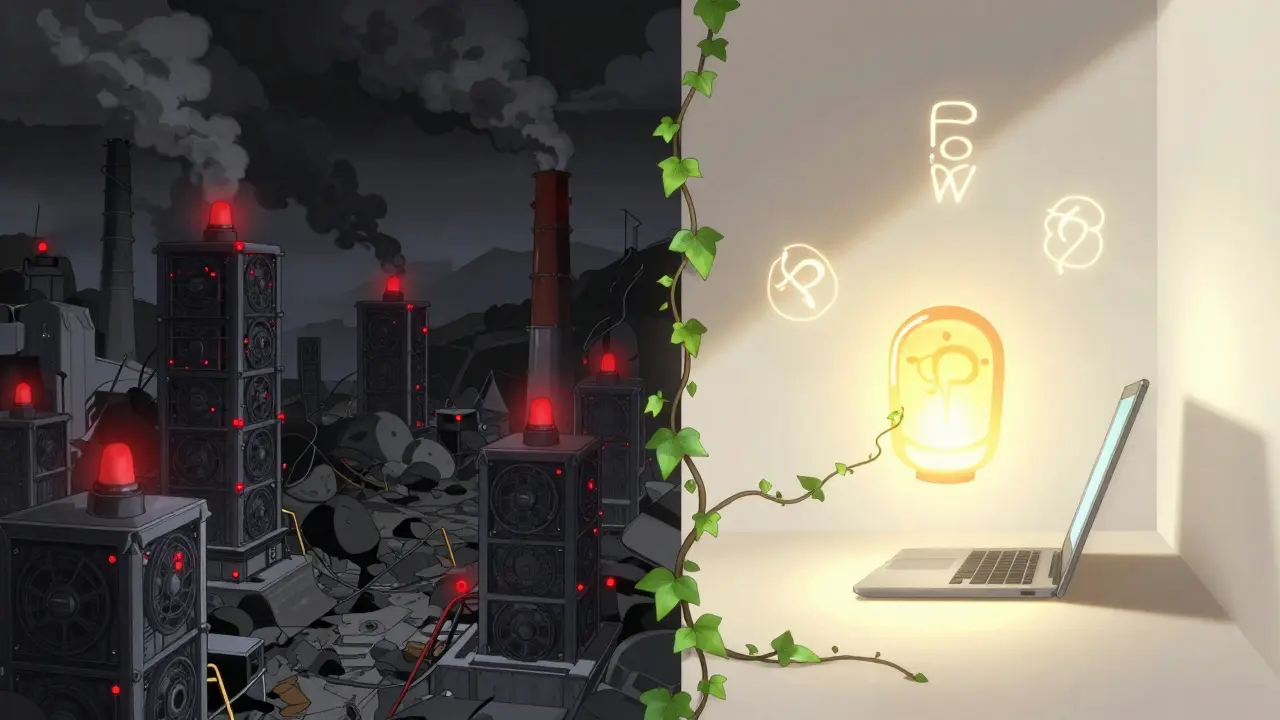
Before September 15, 2022, blockchain networks like Bitcoin and Ethereum relied on Proof of Work (PoW). This system forced miners to race against each other, using massive amounts of electricity to solve cryptographic puzzles. The winner got rewarded with new coins. But the real cost wasn’t just in electricity bills - it was in carbon emissions. Bitcoin alone was using 112.06 terawatt-hours (TWh) of energy per year in 2022. That’s more than the entire country of Belgium. And for what? To validate transactions that could be done with a fraction of the power.
What Proof of Stake Actually Does
Proof of Stake (PoS) changed everything. Instead of miners competing with brute-force computing, PoS lets validators participate by locking up - or staking - their own cryptocurrency as collateral. The more you stake, the higher your chance of being chosen to validate the next block. No need for expensive hardware. No need for cooling systems. No need to run machines 24/7.
It’s not magic. It’s math. PoS removes the wasteful race. In PoW, thousands of machines are solving the same problem at once. Only one wins. The rest? Their energy is gone. PoS picks one validator fairly - based on how much they have at risk - and that’s it. No duplicates. No wasted cycles.
The Ethereum Foundation confirmed this after The Merge: Ethereum’s energy use dropped by 99.95%. Before, it used as much power as a small country. After? Less than 2,100 average American homes. That’s a 11,206 times reduction. In practical terms, one Ethereum transaction now uses 0.0026 kWh. Bitcoin? 707 kWh per transaction. That’s over 270,000 times more energy.
Real Numbers, Real Impact
Let’s put that into perspective.
- Bitcoin’s annual carbon footprint in 2022: 62.51 million metric tons of CO2.
- Ethereum post-Merge: 0.01 million metric tons of CO2.
- Tezos, Solana, Cardano, and Polkadot - all PoS networks - consume less than 0.001% of Bitcoin’s energy.
These aren’t estimates. These are measurements from the Ethereum Foundation, the Cambridge Centre for Alternative Finance, and the Crypto Carbon Research Institute. The numbers don’t lie.
And it’s not just Ethereum. The Casper Network, launched in 2020, runs entirely on PoS. It doesn’t just claim to be green - it measures its energy use per validator and publishes it publicly. Even small validators running on a $500 laptop can contribute without burning through electricity.
Why This Matters Beyond Crypto
Businesses aren’t ignoring this. Companies that once hesitated to touch blockchain because of its environmental cost are now rushing in. Gartner’s 2023 survey found 68% of Fortune 500 companies experimenting with blockchain now choose PoS networks - up from just 32% in 2021. Why? Because sustainability is no longer optional. The European Union’s MiCA regulation, effective in 2024, forces all blockchain platforms operating in the EU to disclose their carbon footprints. PoW networks? They’re now at a legal disadvantage.
Supply chain tracking, digital identity, and ESG reporting are all moving to PoS blockchains. The Casper Network reported a 210% jump in enterprise adoption in 2023, with companies citing “regulatory compliance” as their top reason. It’s not about ideology anymore - it’s about risk. And PoS reduces risk dramatically.
What You Need to Run a Validator
Running a PoS node doesn’t require a warehouse full of mining rigs. Ethereum’s official guidelines say you need:
- 8 GB of RAM
- 500 GB of SSD storage
- A stable internet connection
That’s a standard home computer. No special cooling. No loud fans. No $10,000 ASIC miners. Even someone with basic tech skills can set up a validator in 2-4 hours. Compare that to PoW, where miners needed electrical infrastructure upgrades, industrial cooling, and months of setup.
And you don’t even need 32 ETH to start. Liquid staking services like Lido and Coinbase let you stake as little as 0.01 ETH. You get staking rewards without locking up a fortune. Over 78% of users surveyed by Trustpilot in late 2022 said they chose staking services because of the environmental benefit.
Is PoS Perfect? Not Quite.
There are real concerns. The biggest one? Centralization. If you have more coins, you have more chances to validate. That means big staking pools - like Lido, Coinbase, or Kraken - control a large chunk of the network. In early 2023, the top 10 staking pools held over 40% of Ethereum’s total stake. That’s not decentralized by design.
But Ethereum’s team is already working on fixes. Sharding - splitting the network into smaller pieces - will let more people validate without needing huge amounts of ETH. And slashing penalties (where validators lose part of their stake for going offline or cheating) make bad behavior expensive. These aren’t theoretical fixes - they’re live and being tested.
Another myth? That PoS is less secure. It’s not. PoS uses economic incentives instead of hardware power. If a validator tries to cheat, they lose their staked coins. That’s a stronger deterrent than burning electricity. Bitcoin’s PoW has never been hacked - but that’s because it’s expensive to attack. PoS makes attacks even more expensive, because you’d need to buy up a majority of the entire network’s supply.

The Future Is Already Here
By 2025, Delphi Digital predicts 80% of new blockchain projects will use PoS or a variant. Ethereum’s roadmap includes full sharding by 2026 - which will scale the network to handle tens of thousands of transactions per second, all while using the same tiny amount of energy.
And it’s not just Ethereum. Cardano, Solana, Polygon, and Cosmos are all PoS. Even new projects like Celestia and Sei are built on PoS from day one. The era of energy-hungry blockchains is ending. Not because of protests. Not because of regulations alone. But because the technology simply works better.
Every time you use a DeFi app, send a token, or trade NFTs on a PoS chain, you’re not just moving money - you’re helping cut carbon. You don’t need to be a miner or a developer to make a difference. Just choose a PoS network. And that’s how change happens - one transaction at a time.
Is Proof of Stake really 99.95% more energy efficient than Proof of Work?
Yes. Ethereum’s transition from PoW to PoS in September 2022 cut its energy use from 112.06 TWh per year to just 0.01 TWh. That’s a 99.95% reduction, confirmed by the Ethereum Foundation, the Cambridge Centre for Alternative Finance, and multiple independent researchers. The same efficiency applies to other PoS networks like Cardano and Solana compared to Bitcoin.
Can I stake crypto without buying expensive hardware?
Absolutely. You don’t need ASIC miners or industrial cooling. To run a full PoS validator, you need a standard computer with 8 GB RAM and 500 GB SSD. But most people use liquid staking services like Lido, Coinbase, or Kraken, which let you stake as little as 0.01 ETH. These services handle the technical side - you just earn rewards.
Does PoS make blockchains less secure than PoW?
No. PoS replaces computational power with economic incentives. To attack a PoS network, you’d need to buy up over 50% of all staked coins - which would cost billions and make the attack self-defeating. If you try to cheat, you lose your stake. This is harder and more expensive than attacking PoW, where you’d only need 51% of the mining power.
Why are governments pushing for PoS?
Because PoW blockchains like Bitcoin use more energy than entire countries. The EU’s MiCA regulation (2024) requires all crypto platforms to report their carbon emissions. PoW networks can’t meet these standards without drastic cuts - but PoS networks already do. Companies using PoS for supply chains, identity, and finance can now comply with ESG rules easily.
Is Bitcoin going away because of PoS?
No. Bitcoin’s network is too large and entrenched to switch. But it’s no longer the standard for new projects. Over 47% of the non-Bitcoin crypto market now runs on PoS. New blockchains - from enterprise tools to DeFi apps - are built on PoS because it’s cheaper, faster, and greener. Bitcoin will remain, but it’s becoming the exception, not the rule.
What’s Next?
If you’re using crypto, ask yourself: Which network are you on? If it’s still PoW, you’re contributing to a system that uses more energy than most households. If it’s PoS, you’re part of the shift. The tools are simple. The choice is yours. And the data is clear - the future of blockchain isn’t about how hard you mine. It’s about how little energy you waste.
Ruby Ababio-Fernandez
February 16, 2026 AT 17:02Jenn Estes
February 17, 2026 AT 08:22James Breithaupt
February 17, 2026 AT 08:54Scott McCrossan
February 18, 2026 AT 09:28Jeremy Fisher
February 18, 2026 AT 22:39AJITH AERO
February 19, 2026 AT 08:45Angela Henderson
February 20, 2026 AT 08:09sruthi magesh
February 21, 2026 AT 05:58Kyle Tully
February 22, 2026 AT 13:51Ian Plunkett
February 24, 2026 AT 03:39yogesh negi
February 25, 2026 AT 23:03george chehwane
February 27, 2026 AT 21:40Rajib Hossaim
February 28, 2026 AT 18:20Beth Erickson
March 1, 2026 AT 10:35Anandaraj Br
March 3, 2026 AT 08:52Aileen Rothstein
March 3, 2026 AT 14:56Jennifer Riddalls
March 4, 2026 AT 06:49Geet Kulkarni
March 5, 2026 AT 03:42Alex Williams
March 6, 2026 AT 01:21Sarah Shergold
March 7, 2026 AT 18:10