
Is Qmall Exchange a Real Crypto Platform or Just Another Hype?
If you’re looking for a crypto exchange with zero trading fees and official EU regulation, Qmall Exchange (QMALL) sounds like a dream. But dig a little deeper, and the picture gets messy. This isn’t just another exchange trying to stand out-it’s one wrapped in contradictions. On one side, you’ve got a 4.4-star rating on Google Play with over 50,000 downloads. On the other, users are reporting that after selling their crypto, 33% of their funds vanished. Some say it’s regulated by the EU. Others say it’s not regulated at all. So who’s telling the truth?
Let’s cut through the noise. Qmall Exchange claims to be the first crypto platform fully regulated by the Ukrainian government and licensed in Lithuania. But here’s the problem: no major crypto data site like CoinGecko or CoinMarketCap lists Qmall in its top 100 exchanges. Why? Because they require verified trading volume, clear regulatory documentation, and transparent operations. Qmall gives none of that.
Regulation? The Big Confusion
Qmall says it’s registered in Lithuania as a Virtual Currency Exchange Operator under UAB QMALL. That sounds legit-until you check Lithuania’s official Financial Crime Investigation Service database. No public record confirms this registration. Meanwhile, FinanceMagnates says it’s EU-regulated. FxVerify, a firm that checks crypto platform legitimacy, says it’s not regulated by any government authority. Traders Union, a group that tracks exchange reliability, gives Qmall a 1.6 out of 5. That’s a failing grade.
Even more confusing: Qmall claims to be regulated by Ukraine. But Ukraine doesn’t have a formal licensing system for crypto exchanges yet. The National Bank of Ukraine has only issued guidance-not licenses. So if Qmall says it’s “fully regulated by Ukraine,” that’s misleading at best.
Here’s what matters: if an exchange isn’t listed on official government registries, you can’t trust its claims. No regulatory seal means no legal protection if things go wrong. And in crypto, things go wrong often.
Zero Fees? Not Quite
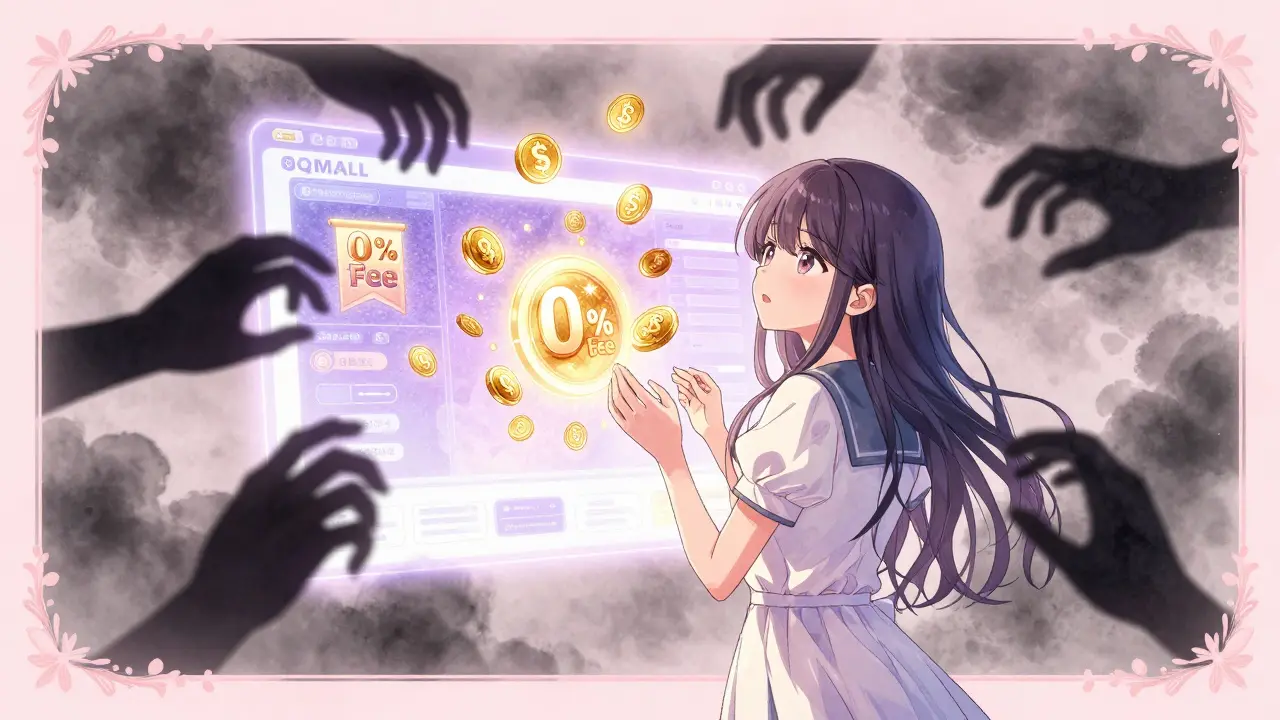
Qmall advertises 0% maker and taker fees. Sounds too good to be true? It is. Because while trading might be free, withdrawals and conversions aren’t. Multiple users report massive hidden charges. One review says: “After selling my coin, they took 33% of the total value.” Another says they were hit with a 50% extra fee on blockchain transactions. That’s not a fee-it’s a robbery.
Compare that to Kraken, Binance, or KuCoin. Even their highest fees are under 0.4%. Qmall’s model looks like a bait-and-switch: lure you in with zero trading fees, then nickel-and-dime you on every step out. And if you’re trying to cash out in EUR or USD? Good luck finding clear withdrawal limits or processing times. The platform doesn’t publish them.

Low Traffic, High Claims
Qmall’s website gets around 6,700 visits per month. That’s less than a small local coffee shop in Wellington gets on a busy Saturday. Kraken alone sees over 10 million visits per month. Even smaller exchanges like Bitstamp get 200,000+. Qmall’s traffic rank? 364th out of 586 crypto exchanges. That’s near the bottom.
And here’s what that tells you: if no one’s using it, why should you? High traffic means liquidity. Liquidity means you can buy and sell without slippage. With Qmall, you’re gambling that someone will take your trade. If you try to sell 10 BTC, you might get stuck with a partial fill-or worse, your order gets canceled without warning.
The Mobile App vs. Reality
The Qmall app on Google Play has a 4.4-star rating from 838 reviews. That seems great-until you read the reviews. The top-rated ones praise the app’s clean interface and fast login. But the negative ones? They’re terrifying.
- “My withdrawal took 11 days. No updates. No response from support.”
- “They froze my account after I sold 0.5 ETH. Asked for ID I already sent. Then disappeared.”
- “The app works fine. The exchange? A scam.”
That’s the split: the app is functional, but the backend? Broken. You can deposit and trade smoothly-but when you try to withdraw? That’s when the silence kicks in. Support email? [email protected]. No phone number. No live chat. Just an email address with no public response time.

The Metaverse Dream
Qmall’s founders talk about a “Metaverse” where you can spend QMALL tokens in virtual bars, cinemas, and shops. Sounds cool. But it’s all vaporware. No demo. No beta. No public roadmap. No third-party verification. It’s a marketing gimmick to make the token seem valuable.
And what’s the QMALL token even worth? No major exchange lists it. No DeFi protocol uses it. It doesn’t appear on CoinGecko or CoinMarketCap. It’s not even on Uniswap or PancakeSwap. That means you can’t trade it elsewhere. If you buy QMALL tokens on this exchange, you’re stuck. You can’t cash out unless Qmall lets you-and as we’ve seen, they might not.
Who Is This For?
Let’s be honest: Qmall Exchange isn’t for most people. It’s not for traders who want liquidity. It’s not for investors who want security. It’s not for Europeans who want real regulation.
It might appeal to one group: Ukrainian users who believe the “regulated by Ukraine” claim and have no access to bigger exchanges. Even then, the lack of verified support, hidden fees, and no public trading volume make it risky.
If you’re outside Ukraine and thinking of using Qmall, ask yourself: why not use a platform with 10 million users, clear regulation, and real customer service? Why risk your crypto on a platform that can’t even prove it exists legally?
Final Verdict: Avoid Unless You’re Willing to Lose Money
Qmall Exchange is a classic example of a platform built on hype, not substance. It uses shiny app design, fake regulatory claims, and a Metaverse fantasy to distract from its core failures: no transparency, no liquidity, no real support, and hidden fees.
There are dozens of better alternatives. Kraken, Binance, Bybit, KuCoin-all have verifiable licenses, public trading volumes, and responsive support teams. They charge fees, yes. But you know exactly what you’re paying. With Qmall, you pay in uncertainty.
If you’ve already used Qmall and lost funds? You’re not alone. But there’s no recovery path. No ombudsman. No insurance. No legal recourse. That’s the cost of choosing a platform that doesn’t want to be found.
Stick with exchanges that answer to regulators, not marketing bros.
Is Qmall Exchange regulated by the EU?
No, Qmall Exchange is not regulated by the EU. While it claims registration in Lithuania as a Virtual Currency Exchange Operator, there is no public record of this registration in Lithuania’s official Financial Crime Investigation Service database. Major crypto watchdogs like FxVerify and Traders Union confirm it lacks verifiable regulatory status. The claim of EU regulation appears to be misleading marketing.
Does Qmall Exchange have zero trading fees?
Qmall claims 0% maker and taker fees for trading. But users report hidden fees during withdrawals and conversions. One user lost 33% of their sale value, and another was charged 50% extra on blockchain fees. These aren’t trading fees-they’re extraction fees. What looks like zero fees is actually a trap.
Is the QMALL token worth buying?
No. The QMALL token is not listed on any major exchange, DeFi protocol, or trading platform. It has no real utility outside Qmall’s own ecosystem, which has no public proof of operation. The Metaverse project it’s tied to doesn’t exist yet. Buying QMALL tokens means locking your money into a platform that may not let you cash out.
Why does Qmall have a 4.4-star app rating if it’s risky?
The app’s high rating comes from users who only test the interface-depositing, trading, and viewing balances. The real problems happen during withdrawals or customer support requests, which users often don’t review. Positive ratings reflect usability, not safety. The exchange’s backend and support are broken, but the app looks polished.
Can I trust Qmall Exchange with my crypto?
No. With no verified regulatory status, hidden fees, no public trading volume, and consistent reports of frozen accounts and unresponsive support, Qmall Exchange is not trustworthy. If you can’t verify its legitimacy through independent sources, you shouldn’t deposit funds. Use exchanges with transparent records and global recognition instead.
What are better alternatives to Qmall Exchange?
Use Kraken, Binance, Bybit, or KuCoin. All are regulated in multiple jurisdictions, publish trading volumes, have responsive support, and list major tokens. They charge small fees-but you know what you’re paying. They also have insurance funds, cold storage, and verified compliance. Qmall has none of that.
Why doesn’t CoinGecko list Qmall Exchange?
CoinGecko only lists exchanges that provide verifiable trading volume, regulatory documentation, and operational transparency. Qmall fails all three. It doesn’t publish trading data, can’t prove its regulatory status, and has no public proof of liquidity. Without these, it doesn’t meet the minimum bar for inclusion.
Rachel Stone
January 30, 2026 AT 08:47Tom Sheppard
January 31, 2026 AT 04:06Elizabeth Jones
February 1, 2026 AT 21:52Gurpreet Singh
February 3, 2026 AT 07:25Will Pimblett
February 4, 2026 AT 23:23Tressie Trezza
February 6, 2026 AT 21:58Richard Kemp
February 8, 2026 AT 11:15Nickole Fennell
February 9, 2026 AT 02:52Jerry Ogah
February 9, 2026 AT 06:35Jeremy Dayde
February 9, 2026 AT 10:26Andrea Demontis
February 10, 2026 AT 11:53Joseph Pietrasik
February 11, 2026 AT 08:31Raju Bhagat
February 12, 2026 AT 08:05laurence watson
February 13, 2026 AT 10:24Pamela Mainama
February 14, 2026 AT 15:37Raymond Pute
February 16, 2026 AT 04:47Crystal Underwood
February 17, 2026 AT 09:40Gustavo Gonzalez
February 18, 2026 AT 22:36Mark Ganim
February 20, 2026 AT 17:06Jeremy Dayde
February 21, 2026 AT 06:45Edward Drawde
February 23, 2026 AT 03:10Rico Romano
February 23, 2026 AT 23:46