
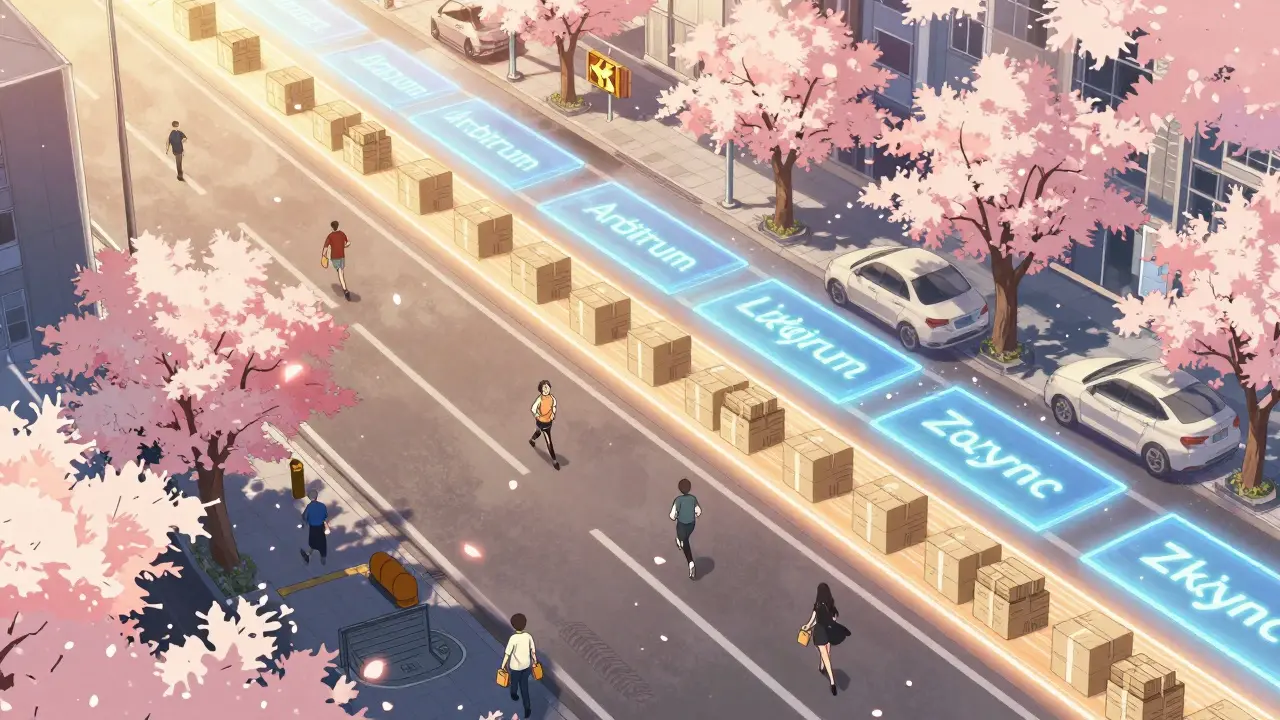
Blockchains are fast, but not fast enough. If you’ve ever waited minutes for a transaction to confirm or paid $50 in gas fees just to swap tokens, you know the problem. The blockchain trilemma - security, decentralization, and scalability - means you can only pick two. Most networks chose security and decentralization, and now they’re paying the price in speed and cost. That’s where sharding and Layer 2 solutions come in. They’re not just buzzwords. They’re two completely different ways to fix the same broken system.
What Layer 2 Solutions Actually Do
Layer 2 solutions don’t change the main blockchain. Instead, they build a side highway on top of it. Think of Ethereum as a two-lane road that gets jammed every time someone sends a transaction. Layer 2s are like adding dozens of express lanes that bundle up hundreds of transactions, then send one single summary back to the main road. This cuts down congestion and lowers fees. There are two main types: optimistic rollups and ZK-rollups. Optimistic rollups assume everything is fine unless someone proves it’s not. If someone tries to cheat, they have a 7-day window for others to challenge them with a fraud proof. ZK-rollups use math - zero-knowledge proofs - to prove transactions are valid without showing the details. It’s like handing someone a sealed envelope that says, “I did 100 transactions correctly,” and they can verify it without opening it. Right now, Ethereum’s biggest Layer 2s are Arbitrum, Optimism, ZkSync, and Polygon zkEVM. Together, they handle over 70% of all Ethereum transactions. Users save money. DeFi apps run smoother. NFTs mint faster. But here’s the catch: every transaction still has to be settled on Ethereum. That means if Ethereum gets busy, even Layer 2s slow down.What Sharding Is and Why It’s Different
Sharding doesn’t add lanes. It breaks the road into 64 separate highways - all running at once. Instead of every node in the network processing every transaction, each node only handles its own shard. One shard might process NFT sales. Another handles DeFi swaps. A third manages gaming assets. All of them work in parallel. This isn’t theory. Ethereum 2.0 is building it. NEAR Protocol already runs it. In a sharded system, a node doesn’t need to store the whole blockchain. It only stores its shard’s data. That cuts storage costs by up to 40% on NEAR. It also means transactions confirm in seconds, not minutes. If one shard gets overloaded with 10,000 transactions per minute, the others keep going. No bottleneck. The real power? Native cross-shard communication. If you’re trading an NFT on Shard A and using a DeFi app on Shard B, the blockchain handles it automatically. No bridges. No wrapping tokens. No waiting for confirmations across chains. It just works - like a single system.
Security: Who’s Really in Charge?
Layer 2s depend on Ethereum for security. They’re like renters. Ethereum owns the building. The Layer 2 runs the business inside. If Ethereum goes down, so do the Layer 2s. But Ethereum’s security is rock-solid. That’s why ZK-rollups are so trusted - their proofs are verified on-chain using the same math that secures Bitcoin. Sharding, on the other hand, is built into the foundation. Every shard inherits security from the main chain. But here’s the risk: cross-shard communication is complex. If one shard gets hacked or misbehaves, it could affect others. That’s why Ethereum’s sharding design includes data availability sampling (DAS) - a way to check that all transaction data is actually there and not hidden. Vitalik Buterin put it simply: Layer 2s are like independent startups. Sharding is like a company restructuring its departments to work better together. One is flexible. The other is integrated.Cost and Efficiency: Who Wins?
Layer 2s win on immediate cost savings. Transactions on Arbitrum cost pennies. ZkSync is even cheaper. For users, that’s a dream. But there are hidden fees. Moving money from Ethereum to Arbitrum costs gas. Getting it back costs more. And if you’re using multiple Layer 2s - say, Optimism for swaps and ZkSync for gaming - you’re juggling wallets, bridges, and delays. Sharding doesn’t have those layers. Everything runs on one chain. No bridging. No token wrapping. No waiting for finality across chains. Nodes use less storage. Less power. Less cost to run. That’s why NEAR and Solana (which uses a similar parallel approach) can offer near-zero fees without sacrificing speed. For long-term growth, sharding wins. Layer 2s are great for now. But if you want a blockchain that scales to billions of users - like a global payment network or a metaverse with millions of active players - sharding is the only architecture that can handle it without adding complexity.
Lisa Parker
February 20, 2026 AT 16:23Ugh I just tried to swap some tokens on Ethereum and got charged $47 in gas. Like bro, this isn't 2017 anymore. Layer 2s saved my sanity. Arbitrum literally let me do 10 trades for less than a dollar. Why are we still talking about sharding like it's some magic future solution? We need solutions NOW, not in 2027.
Aileen Rothstein
February 22, 2026 AT 11:54This is one of the clearest breakdowns I've seen. Layer 2s are the Band-Aid, sharding is the surgery. And honestly? We need both. Right now, Layer 2s are keeping DeFi alive. But if we want Web3 to scale to billions, we need the underlying chain to handle the load. Sharding isn't just nice to have - it's the only way to avoid a fragmented mess of 50 different L2s with no interoperability.
Also, the part about cross-shard communication? That's the real game-changer. No more bridges. No more wrapped ETH. Just move your NFT from gaming to DeFi like it's one seamless world. That’s the future.
Ian Plunkett
February 23, 2026 AT 09:45Layer 2s are a scam. 🤡
Ethereum is a dying gaslight. They’re just outsourcing the congestion to other chains while pretending they’re scaling. ZK-rollups? More like ZK-illusion. All those ‘low fees’? Still rely on Ethereum’s L1. What a joke. Sharding is the only real path. Everything else is just financial engineering with a blockchain sticker.
Avantika Mann
February 24, 2026 AT 04:46I love how you broke this down - it’s so easy to understand! I’m just starting out in crypto and this made so much sense. I was confused about why everyone was using Arbitrum instead of just waiting for Ethereum 2.0. Now I get it - Layer 2s are like temporary Wi-Fi boosters while the main router gets upgraded. And sharding? That’s the whole new internet cable installation. 🙌
Sasha Wynnters
February 25, 2026 AT 19:04Let’s not pretend this is about technology. This is about control. Layer 2s are corporate capture disguised as innovation. They create gated communities inside Ethereum - where only the wealthy can afford to play. Sharding? That’s decentralization in its purest form. No middlemen. No bridging fees. Just raw, parallel, permissionless throughput. The elites want Layer 2s because they can regulate them. Sharding? Too anarchic. Too real.
It’s not about speed. It’s about sovereignty.
Charrie VanVleet
February 27, 2026 AT 13:07YES. This. I’ve been saying this for years. Layer 2s are the bridge, not the destination. 🚧
I remember when we had to use centralized exchanges just to move ETH between chains. Now? I use ZkSync for swaps, Arbitrum for lending, and Polygon for NFTs. It’s a mess. But it works. Meanwhile, sharding is coming - and when it does, it’ll make this whole juggling act look like dial-up internet.
Don’t hate the Layer 2s. They’re the heroes we need right now. But don’t mistake them for the heroes we want.
🚀
Scott McCrossan
March 1, 2026 AT 00:47Sharding? More like shattering. Ethereum 2.0 is a dumpster fire waiting to ignite. They’ve been ‘coming soon’ for 5 years. Meanwhile, Solana and NEAR are already doing it. Real transactions. Real speed. Real users. Ethereum’s L2s are just a way to keep the hype train running while they delay the inevitable. You think ZK-proofs are secure? They’re just math magic until someone finds the exploit. And when they do? All your ‘secure’ L2s collapse.
Rajib Hossaim
March 2, 2026 AT 08:40This is a very thoughtful analysis. I appreciate the distinction between immediate utility and long-term architecture. In India, where data costs and transaction fees are critical barriers, Layer 2s have enabled access to DeFi for millions who otherwise couldn’t afford Ethereum. But I agree - for true global scalability, sharding must be the foundation. The future lies in hybrid systems, not either/or.
Beth Erickson
March 4, 2026 AT 02:18Layer 2s are just crypto’s version of Uber Eats - they don’t fix the restaurant, they just make you pay more to get food faster
Sharding is the only real answer. Why are we still pretending Ethereum can scale with band-aids? We’re not building a blockchain. We’re building a Frankenstein monster.
Ruby Ababio-Fernandez
March 5, 2026 AT 05:28Sharding is still a pipe dream. L2s work now.
Jenn Estes
March 6, 2026 AT 00:28You sound like a blockchain evangelist who’s never actually used a wallet. Have you tried moving assets between Arbitrum and ZkSync? It’s a nightmare. Gas fees. Delays. Confusion. You’re romanticizing sharding like it’s some utopian ideal. Meanwhile, real people are stuck paying $20 to bridge their own tokens because you think ‘native interoperability’ sounds cool.
Angela Henderson
March 7, 2026 AT 02:42So basically, Layer 2s are like adding more lanes to a highway while sharding is like building 64 separate highways that all connect automatically? Yeah, that makes sense. I used to think sharding was just a fancy word for splitting things up, but now I get it. It’s like if your phone had 64 processors instead of one, and each one handled a different app. No lag. No waiting. Just smooth. I like that. I’ve been using Arbitrum for a while and it’s great, but I can see why someone would want sharding in the long run. It’s just… slower to get there, right? Like waiting for a new house to be built instead of renting a nice apartment.
Also, I didn’t know NEAR was already doing it. That’s kinda wild. I thought Ethereum was the only one trying to fix this.
James Breithaupt
March 7, 2026 AT 09:40From a systems architecture standpoint, Layer 2s are a classic example of vertical scaling vs. horizontal. Rollups optimize throughput by aggregating transactions - a throughput-centric model. Sharding is horizontal partitioning - a throughput-and-latency-centric model. The trade-off? L2s inherit L1’s security model but introduce new trust assumptions (sequencers, fraud proofs). Sharding reduces per-node load, enabling true decentralization at scale - but requires robust cross-shard consensus and data availability. DAS is non-negotiable here. Without it, you’re vulnerable to data withholding attacks. That’s why Ethereum’s approach is superior: it’s not just scaling - it’s rearchitecting for Byzantine fault tolerance at 100k TPS.
Also, calling Polygon zkEVM a Layer 2 is technically inaccurate. It’s a ZK-rollup with Ethereum equivalence. But that’s semantics.
Alex Williams
March 8, 2026 AT 07:02Big picture: Layer 2s are the MVP. Sharding is the endgame. If you’re building a startup today, you deploy on Optimism. No question. But if you’re building the next Meta or Spotify on-chain? You need sharding. Why? Because users shouldn’t care which shard they’re on. They shouldn’t have to bridge. They shouldn’t have to manage 3 wallets. The magic of sharding is that it makes blockchain feel like a single system - not a patchwork of chains. That’s the user experience we’re fighting for.
Also, gas fees on L2s are low, but they’re still not zero. And every time Ethereum congests, L2 sequencers get backed up. Sharding removes that dependency entirely. Nodes don’t need to store everything. That’s how you get mobile phones running full nodes. That’s how you get global adoption.
Don’t sleep on NEAR. They’ve been sharding since 2019. And yes - it works.
Sarah Shergold
March 10, 2026 AT 00:43L2s are for normies. Sharding is for real degens who want to feel the raw power of a distributed ledger without some corporate rollup team deciding which txns get prioritized. Also, ZK-proofs are just math voodoo. I’ve seen the code. It’s not magic. It’s a black box. Give me sharding any day. Solana’s already there. Why are we still clinging to Ethereum’s corpse?
Andrew Edmark
March 10, 2026 AT 19:31Love this breakdown. Seriously. I’ve been in crypto since 2017 and this is the clearest explanation I’ve read. I think a lot of people don’t realize how much L2s have already saved the ecosystem. Without them, Ethereum would’ve collapsed under its own weight. But sharding? That’s the real unlock. Imagine a world where your gaming NFT moves seamlessly into your DeFi portfolio. No bridges. No waiting. Just… flow. That’s the future. And it’s closer than you think.
🙌
Dominica Anderson
March 11, 2026 AT 04:03Layer 2s are just a way for VCs to fund another startup that’ll eventually be acquired by ConsenSys. Sharding is the only thing that actually decentralizes. Everything else is just Wall Street with a blockchain logo.
sruthi magesh
March 12, 2026 AT 00:39Sharding? LOL. You think the Ethereum Foundation isn’t controlled by the same people who run the Fed? They want you to believe sharding is the answer so you keep buying ETH while they quietly centralize sequencers under their ‘Ethereum Alliance’. Layer 2s? Even worse. They’re honeypots for surveillance capitalism. Your transactions are logged, tracked, sold. Sharding doesn’t fix that. It just makes it faster. The real solution? Abolish blockchain. Go back to cash.
Nova Meristiana
March 12, 2026 AT 04:48Sharding is overrated. Everyone’s acting like it’s the second coming. Meanwhile, Solana does 65k TPS with 100% finality. No sharding. No rollups. Just… good engineering. Why are we still pretending Ethereum has any technical edge? L2s are just a crutch for a broken design. The real innovation isn’t in sharding - it’s in moving on.
JJ White
March 13, 2026 AT 09:15THIS. This is why I hate crypto discourse. Everyone’s obsessed with ‘scalability’ like it’s a math problem. It’s not. It’s a political one. Layer 2s are corporate control. Sharding is decentralization. But Ethereum’s sharding isn’t real decentralization - it’s ‘permissioned sharding’ with centralized sequencers. The real revolution? A blockchain that doesn’t need L1 at all. A peer-to-peer mesh where every node is equal. That’s what we’re missing. All this talk about rollups and shards? It’s just rearranging deck chairs on the Titanic.
And don’t get me started on ZK-proofs. They’re not secure. They’re just encrypted. And encryption can be broken. Math doesn’t save you. Governance does.
Nicole Stewart
March 14, 2026 AT 07:53L2s work. Sharding is vaporware. End of story.
Alan Enfield
March 14, 2026 AT 11:10Interesting take. I think both have their place. Layer 2s are great for immediate use cases - DeFi, NFTs, gaming. But if we want to onboard billions, we need sharding. It’s not a competition. It’s evolution. The real win is when L2s become obsolete because the L1 can handle the load. That’s the goal.
Jennifer Riddalls
March 14, 2026 AT 18:11I just started learning about this and this post helped me so much. I didn’t realize how much bridges were slowing things down. Now I get why sharding matters. It’s not just about speed - it’s about making crypto feel natural. Like using the internet. No extra steps. Just do it. Thank you for writing this.
Kyle Tully
March 16, 2026 AT 02:45You’re all missing the point. Sharding isn’t the answer because Ethereum will never fully implement it. The team is too bloated. Too bureaucratic. The real future is in non-Ethereum chains - Solana, NEAR, Sui. They’re already doing it. Layer 2s are just a way to keep Ethereum alive while the real innovation happens elsewhere. We’re not waiting for sharding. We’ve already moved on.
And don’t get me started on ZK-rollups. They’re not secure. They’re just complex. And complexity is the enemy of decentralization.
kieron reid
March 16, 2026 AT 16:04L2s are fine. Sharding? Too complicated. Who cares? Just let me swap tokens cheap.
Aileen Rothstein
March 16, 2026 AT 22:05One thing everyone’s ignoring: sharding isn’t just about speed - it’s about sustainability. Each node on Ethereum needs to store 1TB+ of data. With sharding, that drops to 20GB. That means your laptop can run a full node. That means farmers in Nigeria can participate. That’s not scalability. That’s liberation.
Alex Williams
March 18, 2026 AT 04:18Exactly. That’s the real win. Right now, running a node requires a $2k server. With sharding, you could run one on a Raspberry Pi. That’s how you get true decentralization. Not by adding more L2s - by making the base layer accessible to everyone.