

If you're in Indonesia and thinking about trading crypto, you’ve probably seen TRIV pop up in ads or forums. It promises low minimum deposits, high leverage futures, and full compliance with local laws. But here’s the real question: is it actually safe-or just loud?
What TRIV Actually Offers
TRIV is not another global exchange trying to squeeze into Indonesia. It was built for Indonesians, by Indonesians. Launched around 2020-2021, it’s headquartered in Jakarta and operates under Indonesia’s Commodity Futures Trading Supervisory Agency (Bappebti), along with the Indonesian Crypto Exchange (CFX) and Jakarta Futures Exchange (JFX). That’s not just marketing fluff-it’s legal requirement. You can trade spot markets for Bitcoin, Ethereum, and Solana. But the real draw is futures trading, launched in February 2025. TRIV now offers perpetual contracts with up to 25x leverage. That’s higher than most local rivals like PINTU and PLUANG. For someone with small capital, this looks tempting. You can start with just IDR 100,000 (about $6.50) or 0.0001 BTC. No bank account? No problem. You can fund your account with local e-wallets like DANA or OVO. Staking is also available for over 25 cryptocurrencies. You can earn passive income on assets like ADA, DOT, and even lesser-known tokens. There’s also crypto-backed lending-deposit your BTC or ETH and borrow IDR against it. It’s all designed to feel familiar to someone who uses GoPay or LinkAja every day.Security: The Big Contradiction
This is where things get messy. TRIV claims to use multi-signature wallets, cold storage, SSL encryption, and two-factor authentication (2FA). Their website says they have “cutting-edge security.” But third-party evaluations tell a different story. Traders Union, a well-known crypto security analyst group, gave TRIV a security score of 4.75 out of 10 in early 2025. That’s below average. For comparison, Kraken scores above 8.5, and even OKX sits at 7.9. Why the gap? Three big reasons:- They don’t have an investor protection fund. If the exchange gets hacked, you’re on your own.
- They lack Tier-1 regulation. No U.S., EU, or UK oversight. Only Indonesian authorities.
- There’s conflicting evidence about 2FA. Traders Union says it’s not offered. TRIV’s own site and some tech blogs say it is. One source even claims they use “password + phone code” for login-sounds like 2FA. But no official guide shows how to enable it.
The KYC Hurdle
You can’t sign up without ID. TRIV requires full KYC: government-issued ID (KTP or passport), proof of address (utility bill or bank statement), and a selfie holding your ID. This isn’t unusual-it’s mandatory under Indonesian law. But it’s a barrier for people who want privacy. Some users on Reddit and local forums complain that verification takes 2-5 business days. That’s slower than PINTU or Tokocrypto, which often approve within hours. If you’re trying to jump into a fast-moving market, that delay can cost you. There’s also no anonymity option. Even if you’re just buying small amounts of Bitcoin to hold, you still need to submit personal documents. If you’re uncomfortable with that, TRIV isn’t for you.
Trading Experience and Interface
The app and website are clean, simple, and in Bahasa Indonesia by default. You can switch to English, but the support team mostly responds in Indonesian. That’s fine if you’re local, but a problem if you’re an expat or non-native speaker. The trading interface is basic. No advanced charting tools, no custom indicators, no order types beyond market, limit, and stop-loss. It’s built for beginners, not day traders. If you’re used to TradingView or MetaTrader, you’ll miss the depth. But for someone who just wants to buy BTC, stake it, and maybe try a 5x leveraged position on ETH? It works. The platform loads fast, deposits are instant, and withdrawals usually hit your wallet within 15 minutes. That’s better than many local exchanges.Regulatory Uncertainty Ahead
Here’s the wildcard: Indonesia is trying to move crypto oversight from Bappebti to the Financial Services Authority (OJK). The plan was to complete this by January 12, 2025. But it didn’t happen. As of February 2025, OJK confirmed they’re still drafting new rules, and talks with the Trade Ministry are ongoing. That means TRIV’s entire legal foundation could shift. If OJK takes over, they might impose stricter rules-like mandatory insurance funds, higher capital reserves, or even banning high-leverage trading. TRIV might have to change everything overnight. Gabriel Rey, TRIV’s CEO, says users don’t need to worry because everything is “officially authorized.” But history shows regulatory changes can wipe out exchanges that aren’t prepared. Remember what happened in South Korea and India? Local exchanges collapsed when rules tightened.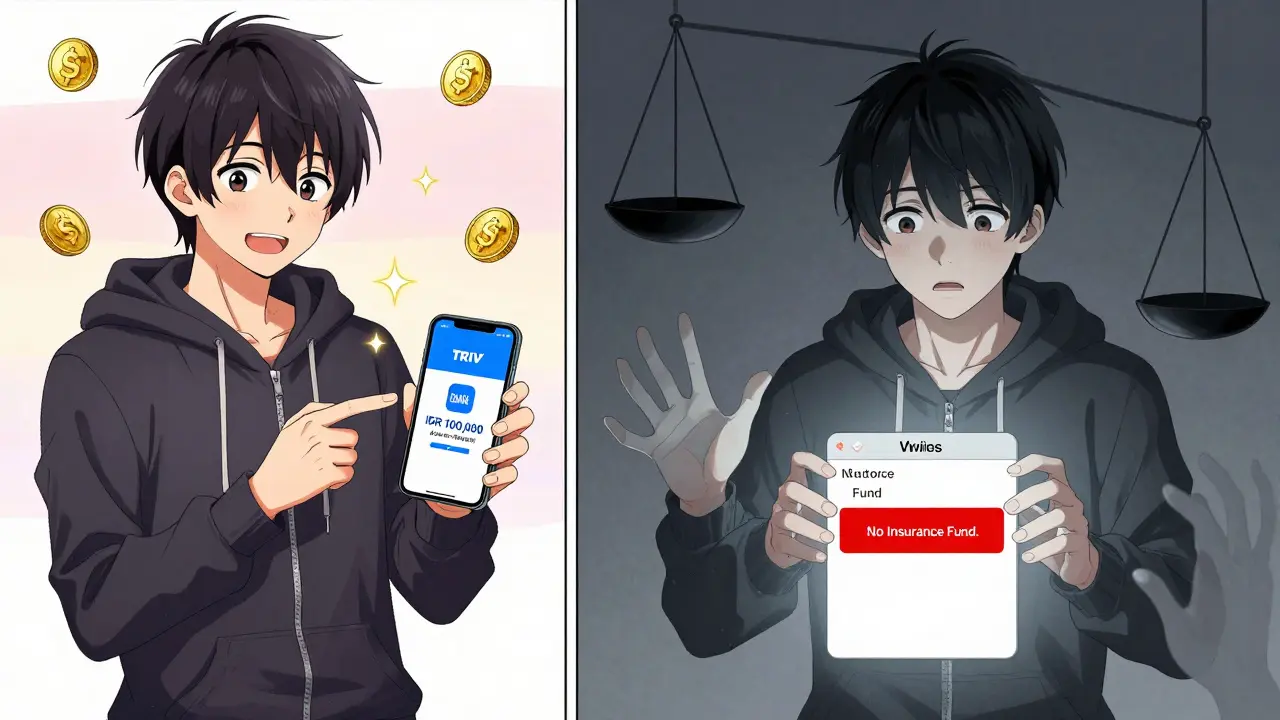
Who Should Use TRIV?
TRIV isn’t for everyone. Here’s who it’s actually good for:- Indonesian retail investors who want to trade legally under local law.
- Beginners who want low entry costs and simple tools.
- Stakers looking to earn yield on Indonesian-supported tokens.
- People who trust government-regulated platforms over global ones.
- High-frequency traders needing advanced charts or APIs.
- Large investors who need insurance funds or Tier-1 regulation.
- Non-Indonesians who can’t complete KYC or get support in English.
- Risk-averse users who can’t accept a 4.75/10 security score.
Alternatives in Indonesia
You don’t have to pick TRIV. Here are two other options:- PINTU - Easier KYC, better app UX, slightly lower leverage (10x), but regulated and trusted by millions.
- PLUANG - Offers futures too, strong customer support, and a more polished interface. They launched futures in late 2024 to compete directly with TRIV.
Final Verdict
TRIV is a legitimate exchange under Indonesian law. It’s not a scam. But it’s not a fortress either. It’s a middle-ground platform: legal, accessible, and risky. If you’re new to crypto in Indonesia and want to dip your toes in with small amounts, TRIV is a reasonable choice. Use only what you can afford to lose. Enable any security features you can find-even if they’re buried in settings. Don’t store large sums there. And keep an eye on news about OJK’s new rules. If you’re serious about trading, want insurance protection, or plan to hold big amounts of crypto? Look elsewhere. Global exchanges like Kraken or Coinbase (if you can access them) are safer, even if they’re harder to use in Indonesia. TRIV fills a niche. It’s not the best. But for many Indonesians, it’s the only one that feels officially safe.Is TRIV crypto exchange regulated in Indonesia?
Yes. TRIV operates under Indonesia’s Commodity Futures Trading Supervisory Agency (Bappebti), the Indonesian Crypto Exchange (CFX), and the Jakarta Futures Exchange (JFX). It’s one of the few exchanges legally authorized to offer crypto futures in the country as of early 2025.
Does TRIV offer two-factor authentication (2FA)?
There’s conflicting information. TRIV’s website claims to use 2FA and multi-factor authentication, and some tech blogs confirm it. But Traders Union’s 2025 security review states TRIV does not offer 2FA. No official guide shows how to enable it, and users report difficulty finding the option. Until TRIV publishes clear instructions, assume it’s unreliable or missing.
What is the minimum deposit on TRIV?
You can start trading with as little as IDR 100,000 (about $6.50 USD) or 0.0001 BTC. This makes it one of the most accessible exchanges for new users in Indonesia.
Can I withdraw Indonesian Rupiah (IDR) from TRIV?
No. TRIV only supports crypto withdrawals. You can’t directly pull out IDR to your bank account. You’ll need to sell your crypto on TRIV, then transfer the crypto to a local exchange like PINTU or Tokocrypto that supports IDR withdrawals.
Is TRIV safe for long-term holding of crypto?
Not recommended. TRIV has a low security score (4.75/10), no investor protection fund, and unclear 2FA implementation. For long-term holding, move your crypto to a personal wallet like Ledger or Trust Wallet after trading. Never leave large amounts on any exchange.
What happened with the HCoin insider trading allegations?
In 2021, TRIV faced accusations of insider selling of HCoin, its native token, shortly after its launch. TRIV denied the claims, blaming “technical issues.” No official investigation or penalties followed, but the incident remains a red flag for skeptical users. No similar events have occurred since.
Will TRIV survive if Indonesia moves crypto regulation to OJK?
It’s uncertain. The planned shift from Bappebti to OJK was delayed in early 2025. OJK may impose stricter rules-like mandatory insurance funds or limits on leverage. TRIV’s survival depends on how quickly it adapts. If they fail to meet new standards, they could lose their license or be forced to shut down services.
roxanne nott
December 24, 2025 AT 12:16TRIV’s ‘2FA’ is a joke. If you can’t find the toggle in the settings, it doesn’t exist. Just like their ‘cold storage’-probably just a locked closet in Jakarta with a WiFi router.
Lloyd Yang
December 25, 2025 AT 16:02Look, I get it-TRIV isn’t Kraken. But if you’re in Indonesia and you want to trade without jumping through 17 hoops to use a global exchange, this is the least-bad option. I’ve used PINTU, PLUANG, and TRIV. TRIV’s interface is clunky, sure, but the withdrawals are faster than my ex’s apologies. And yeah, no investor fund? Big deal. I only keep what I’m willing to lose. That’s crypto 101. If you’re depositing your life savings into any exchange that isn’t a hardware wallet, you’re already playing Russian roulette with your wallet. TRIV’s security score is low? So’s my dating profile. Doesn’t mean I’m not still getting dates.
Also, the fact they have a hacker bounty program? That’s more than half the ‘regulated’ exchanges in this country. And before you say ‘but global exchanges have insurance,’ tell me how many of those got hacked and paid out? Not many. Most just vanish and rebrand. TRIV at least shows up for work every day.
And the OJK shift? Yeah, it’s a wildcard. But so was every regulatory change in crypto since 2017. Exchanges that survive aren’t the ones with the fanciest logos-they’re the ones that adapt. TRIV’s CEO isn’t a genius, but he’s not an idiot either. He knows his users. He knows the law. And he’s not trying to sell you NFT monkeys. He’s selling you access to Bitcoin with DANA. That’s not a flaw. That’s a feature.
Don’t trust it like your bank. But don’t dismiss it like a scam. Use it like a tool. Keep the big money off it. Enable whatever 2FA you *think* you found. And if you’re still nervous? Buy a Ledger. It’s cheaper than therapy.
Dan Dellechiaie
December 27, 2025 AT 14:13Let me break this down for the ‘regulation is safety’ crowd: Bappebti doesn’t give a flying fuck about your BTC. They care about tax receipts and political optics. TRIV is legal because it pays the right people-not because it’s secure. You think a 4.75/10 security score is ‘fine’ because it’s local? That’s like saying your grandma’s house is safe because it’s in a gated neighborhood where everyone knows each other… and the gate is held shut by duct tape.
And don’t even get me started on ‘crypto-backed lending.’ You deposit ETH, borrow IDR, then the Rupiah tanks 20%? Congrats, you just got liquidated and your ETH is gone. That’s not finance-it’s a pyramid scheme with a UI.
Also, no 2FA? That’s not a bug. That’s a feature for the insiders. Who do you think gets first dibs on the HCoin dump? Not you. Not me. Someone with a backdoor and a KTP.
Shubham Singh
December 29, 2025 AT 08:38TRIV is a regulatory puppet. Bappebti allows it because it keeps retail traders away from offshore platforms. This is not protection-it is control. The moment OJK takes over, TRIV will either vanish or become a sterile shell with zero leverage and 100% bureaucracy. You think you're safe now? You're just being herded.
Jacob Lawrenson
December 29, 2025 AT 20:08Guys. I just bought $200 worth of BTC on TRIV. Withdrawal took 8 mins. App didn’t crash. I didn’t need a passport from 1997 to sign up. And I got staking rewards in 3 days. I’m not a trader. I’m a dad who wants to learn. If this is ‘risky,’ then so is buying a phone on Lazada. But I still do it. TRIV works. Let’s stop overthinking it.
Sarah Glaser
December 31, 2025 AT 09:41There’s a profound irony here: TRIV is the first crypto platform in Indonesia that actually respects local context. It’s not trying to be Binance. It’s trying to be *useful*. The interface is in Bahasa, the funding is via OVO, the compliance is local. That’s not a weakness-it’s cultural intelligence.
And yes, security is imperfect. But so is every system built for scale in emerging markets. The real question isn’t whether TRIV is safe-it’s whether we, as a community, are ready to demand better. Not by fleeing to offshore exchanges we can barely access, but by pushing TRIV to improve: demand transparency, audit reports, clear 2FA guides. If we don’t, who will?
TRIV isn’t the destination. It’s the first step. And sometimes, the first step is all you need to begin.
Jake Mepham
January 1, 2026 AT 14:57Let’s be real: if you’re reading this and you’re in Indonesia, you’re not trading on Kraken. You’re using TRIV, PINTU, or Tokocrypto. Why? Because your bank won’t touch crypto, your phone doesn’t have a US SIM, and your uncle’s WhatsApp group says ‘trust the local one.’
TRIV’s 4.75 security score? Yeah, it’s low. But what’s the alternative? A VPN, a foreign ID, and a prayer? No thanks.
I’ve used TRIV for 18 months. I’ve lost money on bad trades. I’ve never lost money to a hack. I use small amounts. I enable 2FA if I can find it. I don’t store more than 0.01 BTC there. That’s not ignorance-that’s strategy.
Also, the fact they pay ethical hackers? That’s more than I can say for half the banks in Jakarta. If you’re going to trash TRIV, at least have the decency to suggest a better option that works for 95% of Indonesians. Spoiler: there isn’t one.
Rachel McDonald
January 2, 2026 AT 06:22So… TRIV has a ‘hacker bounty program’? That’s cute. Like putting a ‘Beware of Dog’ sign on a house with no fence. 😒
And you’re telling me ‘no investor protection fund’ is fine because you’re only using small amounts? Then why are you even here? If you can’t afford to lose it, why are you playing with futures? You’re not investing-you’re gambling. And TRIV is the casino that lets you use DANA. 🎰
Jayakanth Kesan
January 2, 2026 AT 22:08My cousin used TRIV to buy his first 0.005 BTC last month. He didn’t even know what ‘leverage’ meant. He just wanted to save some rupiah from inflation. He’s happy. No drama. No support tickets. Just a simple app that works. Maybe we don’t need a fortress. Maybe we just need something that doesn’t break when you touch it.
Luke Steven
January 3, 2026 AT 13:17TRIV isn’t about being the safest. It’s about being the most *accessible*. And in a country where 60% of adults are underbanked, accessibility is a form of financial justice.
Yes, the security is shaky. Yes, 2FA is a mystery. But the fact they exist at all? That’s progress. We don’t get to pick the perfect system. We get to pick the one that lets us in.
So if you’re here to shame it for not being Kraken? You’re not helping. You’re just making it harder for the next person to try.
Be the mentor. Not the gatekeeper.
Jordan Renaud
January 3, 2026 AT 19:58Regulation isn’t safety. It’s legitimacy. And legitimacy matters in places where trust is scarce. TRIV doesn’t have to be perfect. It just has to be *consistent*. And so far, it’s been consistent: low fees, fast deposits, local support, and zero scandals since HCoin. That’s more than I can say for half the fintech apps in Jakarta.
Let’s stop pretending global exchanges are the gold standard. They’re not built for us. They don’t speak our language. They don’t care about our KTP. TRIV does. And that’s worth something.
Vijay n
January 5, 2026 AT 01:00TRIV is a front for money laundering. Why else would they allow DANA and OVO without KYC verification delays? The government is asleep. The hackers are waiting. And you’re all just happy to trade with your mom’s ID photo. Wake up. This is not finance. This is a digital Ponzi with a license.
Radha Reddy
January 5, 2026 AT 15:45As someone who grew up in India, I understand the tension between accessibility and security. TRIV reminds me of early Indian fintech platforms-clunky, imperfect, but deeply rooted in local needs. The fact that it supports local wallets, speaks Bahasa, and complies with national law is not a flaw-it is cultural alignment. Security can be improved. Trust, once broken, cannot. Let’s give TRIV the space to evolve, not the pressure to collapse.
Charles Freitas
January 6, 2026 AT 02:03Oh wow. A crypto exchange that doesn’t have a $200M insurance fund? Shocking. And you’re telling me this is ‘reasonable’? You’re not a trader. You’re a hostage to convenience. Go trade on Binance. Use a VPN. Learn to navigate the world outside your bubble. Or keep pretending that ‘local regulation’ means ‘safe.’ Spoiler: it doesn’t.
Sheila Ayu
January 7, 2026 AT 02:16Wait-so TRIV says it has 2FA… but Traders Union says it doesn’t… and users can’t find it… and there’s no guide… and it’s not in the app settings… and yet you’re all still using it? Are you people brainwashed? Or just desperate? Either way, you’re not safe. You’re just… optimistic. 😔
Janet Combs
January 8, 2026 AT 03:44So I tried TRIV. Signed up. Uploaded my KTP. Waited 3 days. Got approved. Bought 0.001 BTC. Staked it. Got 0.00002 extra. It worked. No drama. No emails. No ‘your account is suspended.’ I’m not a pro. I just want to learn. Maybe ‘low security’ just means ‘not for billionaires.’ And that’s okay.
Collin Crawford
January 8, 2026 AT 20:22Let’s be clear: TRIV is not an exchange. It is a regulatory loophole dressed in a UI. The moment OJK takes over, this entire structure will collapse like a house of cards built on a sand dune. Anyone using TRIV for anything beyond ‘small speculative bets’ is playing with fire. And the fire is already lit.
Craig Fraser
January 10, 2026 AT 16:38Why are we even discussing this? It’s clear: TRIV is a compliance checkbox, not a financial institution. If you’re not using a hardware wallet, you’re not serious. If you’re using DANA to buy Bitcoin, you’re not an investor-you’re a tourist. And tourism doesn’t build wealth. It just leaves footprints.
Dan Dellechiaie
January 11, 2026 AT 12:27Oh, so now you’re saying ‘it’s fine because it’s local’? That’s the same logic used by every scammy Ponzis in Southeast Asia. ‘It’s regulated!’ ‘It’s local!’ ‘It’s for us!’ Meanwhile, the devs are in Singapore and the server logs are in the Caymans. Don’t confuse legal with legitimate.