
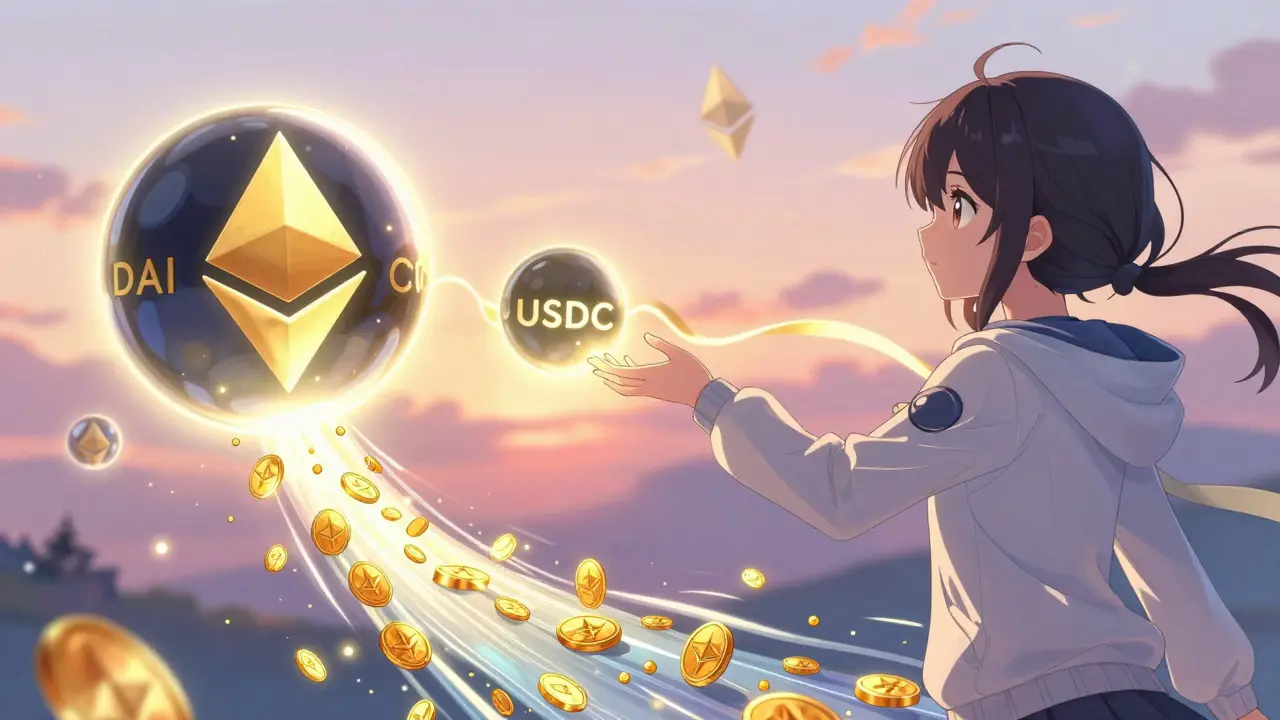
Before Uniswap v2, swapping one crypto token for another on a decentralized exchange meant jumping through hoops. If you wanted to trade DAI for USDC, you had to first swap DAI for ETH, then ETH for USDC. Two transactions. Two sets of gas fees. Two chances for something to go wrong. That changed on May 17, 2020, when Uniswap v2 launched and turned the whole system upside down.
What Made Uniswap v2 Different?
Uniswap v2 didn’t just tweak the old system-it rewrote the rules. The biggest upgrade? Direct ERC-20 to ERC-20 swaps. No more ETH middleman. That single change cut transaction costs by up to 35% for common token pairs and made trading feel instant instead of clunky. It wasn’t just a feature update; it was a UX revolution. Suddenly, obscure tokens like REN, LRC, or even newly launched memecoins could be traded directly without needing to go through ETH first. This opened the door for thousands of new token pairs to appear overnight.
Behind the scenes, each token pair got its own smart contract pool. These pools used a simple math formula: x * y = k. For every token pair, the product of the two token amounts stays constant. When you buy DAI, you increase its price slightly because you’re removing USDC from the pool. This automated pricing is why Uniswap v2 doesn’t need order books, market makers, or centralized servers. It’s all code, running on Ethereum.
The protocol also made ETH easier to use. Instead of forcing users to manually wrap ETH into WETH (Wrapped ETH) before trading, v2 handled it automatically in the background. You sent ETH. You got your tokens. No extra steps. It sounds small, but for new users, it removed a major barrier to entry.
How Uniswap v2 Compared to the Competition
At its peak in late 2020, Uniswap v2 handled 65% of all decentralized exchange volume. That’s more than every other DEX combined. Why? Because it was the easiest, cheapest, and most open option.
Compare it to 0x, another DEX from that era. 0x used an order book model, which meant you had to wait for someone to place a bid or ask. Liquidity was thin. Gas fees? Often over 250,000 units. Uniswap v2? Around 150,000 units. Faster. Cheaper. More reliable.
Even compared to its own predecessor, v1, the difference was night and day. v1 was limited to ETH/ERC-20 pairs. If you wanted to swap one token for another, you had to do two trades. v2 let you do it in one. That’s like upgrading from dial-up to broadband.
But it wasn’t perfect. Compared to later versions like Uniswap v3 (launched in 2021), v2 was inefficient. v3 let liquidity providers concentrate their funds within custom price ranges, boosting capital efficiency by up to 4,000x for stablecoins. v2’s 50/50 pools wasted most of the money sitting idle outside the active trading range. That’s why professional traders and big liquidity providers moved to v3.

Real-World Usage and User Experience
By early 2025, Uniswap v2 still processed about $150 million in daily trades. That’s not huge compared to v3’s $12.7 billion, but it’s still meaningful. Why? Because v2 is where the long-tail tokens live.
Many new, low-volume tokens never got enough liquidity to support v3’s concentrated pools. So they stayed on v2. If you’re trying to trade a token with less than $1 million in total liquidity, v2 is often your only option. That’s why 350,000 monthly active users still show up-mostly people trading obscure projects, early-stage tokens, or testing new DeFi experiments.
Users love that there’s no KYC. No ID. No forms. Just connect your wallet-usually MetaMask, used by 87% of v2 traders-and start swapping. Trustpilot reviews for v2 average 4.2 out of 5 stars. The top praise? “No KYC” and “massive token selection.”
But the complaints? They’re real. Gas fees. During the 2021 NFT boom, a single swap cost over $50. Even today, during Ethereum congestion, fees can spike to $10 or more. That’s why many users now use layer-2 solutions like Arbitrum or Optimism for routine trades. But for tokens not yet available there, v2 remains the fallback.
Security and Risks
Uniswap v2 is open. Anyone can create a token pair. That’s powerful. But it’s also dangerous.
CertiK’s 2024 report found that 1 in every 200 token pairs on v2 was a scam. Some looked legit-same name, same logo, same contract structure. But they were honeypots. If you traded into them, you couldn’t sell. Others were rug pulls. One token called “BANANA” had $2 million in liquidity. Then the devs vanished. All gone.
Always check the contract address. Use tools like Etherscan to verify if a token has been audited. Look at the liquidity pool. If the liquidity is locked for more than a year, that’s a good sign. If it’s unlocked and the owner can withdraw funds? Walk away.
Slippage tolerance matters too. Set it between 0.5% and 2% for most swaps. Go higher? You’re risking a bad price. Go lower? Your trade might fail. Most users don’t know this. They just click “Swap” and hope for the best.
Why Uniswap v2 Still Matters
Uniswap v2 isn’t the future. But it’s the foundation. It’s the reason Sushiswap, PancakeSwap, QuickSwap, and dozens of other DEXs exist. They all forked v2’s code. That’s how big it was.
Vitalik Buterin called it a “critical UX bottleneck solved.” Academic research from UC Berkeley showed it reduced slippage by 1.8% for mid-cap tokens. That’s not a small win. It meant real money saved for everyday users.
Even today, with v3 and Unichain on the horizon, v2 remains active. It’s the graveyard for dead tokens, the testing ground for new ones, and the last resort for tokens that can’t afford v3’s high liquidity requirements. It’s not glamorous. But it’s necessary.
Uniswap v2 proved that decentralized trading didn’t need centralized order books, custodians, or intermediaries. It showed that code could replace human market makers. And it did it with simplicity. No complicated interfaces. No confusing fees. Just connect, swap, and go.
Is Uniswap v2 Still Worth Using?
For most people, no. If you’re trading ETH, USDC, or DAI, go to Uniswap v3 or a layer-2 like Arbitrum. Fees are lower. Slippage is tighter. Liquidity is deeper.
But if you’re trading a token with less than $5 million in liquidity? Or if you’re testing a new project? Or if you’re in a region where layer-2s aren’t fully supported? Then v2 is still your best-and sometimes only-option.
It’s not the future. But it’s still the backbone of DeFi’s wild west. And in crypto, sometimes the old tools are the ones you need when the new ones aren’t ready.
Is Uniswap v2 still operational in 2026?
Yes, Uniswap v2 is still fully operational as of 2026. While most trading volume has moved to Uniswap v3 and layer-2 networks, v2 continues to process around $150 million daily. It remains critical for trading low-liquidity tokens that haven’t migrated to newer versions. The smart contracts are live, liquidity pools are active, and users still interact with it daily.
Can I trade any token on Uniswap v2?
You can trade any ERC-20 token that has a liquidity pool created on Uniswap v2. There’s no approval process-anyone can deploy a pair contract. That means thousands of tokens are available, including many scams and low-quality projects. Always verify the contract address on Etherscan and check for audits before trading.
Why do gas fees on Uniswap v2 vary so much?
Gas fees on Uniswap v2 depend entirely on Ethereum network congestion. Since v2 runs on Ethereum’s mainnet, every swap competes with NFT mints, DeFi transactions, and other dApps. During peak times-like NFT launches or major token airdrops-gas fees can spike to $50 or more. Outside of these periods, fees average $1.50-$3. Using a gas tracker like GasNow helps you time your swaps for cheaper rates.
Is Uniswap v2 safer than centralized exchanges?
It’s safer in some ways and riskier in others. Unlike centralized exchanges, v2 doesn’t hold your funds-you control your wallet. That means no hacks of exchange servers. But it also means you’re responsible for everything. If you send funds to a fake token contract, there’s no customer support to recover them. Always double-check addresses and avoid tokens with low liquidity or no audit.
What wallets work with Uniswap v2?
Any Ethereum-compatible wallet works, but MetaMask is used by 87% of v2 users. Others include WalletConnect, Trust Wallet, Coinbase Wallet, and Argent. You need ETH in your wallet to pay gas fees. You can’t use fiat or other cryptocurrencies directly-you must convert them to ETH or ERC-20 tokens first.
John Doyle
February 11, 2026 AT 17:09Even with the gas spikes, it's the only place where you can test a new project without having to be a whale.
kelvin joseph-kanyin
February 12, 2026 AT 18:06Grace Mugambi
February 14, 2026 AT 06:24It reminds me of old Linux distros: ugly, but reliable.
Benjamin Andrew
February 16, 2026 AT 06:01Anyone using v2 for anything other than testing scams is either naive or masochistic.
Holly Perkins
February 16, 2026 AT 17:52Sanchita Nahar
February 17, 2026 AT 07:52Ben Pintilie
February 17, 2026 AT 08:51Sakshi Arora
February 18, 2026 AT 19:53bala murali
February 18, 2026 AT 22:01While v3 optimizes for capital efficiency, v2 preserves the original ethos: accessibility over optimization. This is not a flaw - it is a philosophical stance.
Ekaterina Sergeevna
February 20, 2026 AT 15:18It’s adorable how people still cling to this relic like it’s a vintage car. Meanwhile, v3 is running on 4,000x capital efficiency and you’re still paying $10 gas to swap two tokens that should’ve never been listed in the first place.
At least admit you’re using it because you’re too lazy to learn how to use a layer-2.
Desiree Foo
February 21, 2026 AT 15:27There’s a moral responsibility here. Using v2 for low-liquidity tokens isn’t activism - it’s enabling criminal behavior. If you care about safety, use v3. Or better yet, stay away from crypto entirely.
Kaz Selbie
February 23, 2026 AT 11:49And the gas? Bro, I paid $47 once for a $5 swap. That’s not innovation - that’s financial abuse. If you’re still on v2, you’re either a masochist or you’re stuck on a country that doesn’t have layer-2 access. Either way, you’re not a pioneer - you’re a cautionary tale.
Robbi Hess
February 25, 2026 AT 00:52The fact that it still operates, unaltered and unyielding, after six years, is a monument to the power of open-source permissionless innovation. It’s not obsolete. It’s eternal.
Keturah Hudson
February 25, 2026 AT 06:31v2 isn’t perfect - but for people outside the US/EU tech bubble, it’s the only door left open.
SAKTHIVEL A
February 26, 2026 AT 16:14By glorifying v2 as a 'foundation,' we are glorifying stagnation. The true legacy of v2 is not its longevity - it is the fact that it forced the industry to evolve. v3 is the evolution. v2 is the corpse.
krista muzer
February 28, 2026 AT 10:11Tammy Chew
March 1, 2026 AT 01:59And don’t even get me started on the slippage. You think you’re getting 0.5%? Nah. You’re getting 5% because you didn’t read the fine print.
It’s not a protocol - it’s a gambling den with a smart contract.
Claire Sannen
March 1, 2026 AT 03:15Technology should serve people, not the other way around. If we abandon v2, we abandon the least privileged in this ecosystem. That’s not innovation - that’s exclusion.
Christopher Wardle
March 1, 2026 AT 09:47It didn’t need hype. It didn’t need a whitepaper. It just worked. And that’s why it still does.
Andrea Atzori
March 2, 2026 AT 02:25But I clicked swap. And it worked. That’s the real power of v2 - it doesn’t require education. It just works.
That’s why I still use it for testing new tokens. It’s the only place where a beginner can fail safely.
Joe Osowski
March 3, 2026 AT 07:07While you’re over there swapping fake tokens, the rest of the world is moving on. You think you’re being ‘decentralized’? You’re just being stupid.
And don’t even get me started on how you’re still using Ethereum mainnet. Go to Arbitrum. Go to Optimism. Or better yet - go back to your fiat bank account and stop wasting everyone’s time.