

Coconut Chicken (CCC) isn’t a company, a product, or a serious investment project. It’s a meme token - born from a tweet, fueled by community chaos, and traded by people who treat crypto like a joke with real money behind it. If you’ve seen it pop up on your crypto tracker and wondered, "What even is this?" - you’re not alone. Let’s cut through the noise and explain exactly what Coconut Chicken is, where it came from, how it’s doing, and whether it’s worth your attention.
Where Did Coconut Chicken Even Come From?
It started with a tweet. On December 22, 2023, Justin Sun - the founder of the TRON blockchain - posted a simple, almost absurd message: "Let’s make a meme coin called Coconut Chicken." No whitepaper. No roadmap. No team announcement. Just a joke. And the TRON community took it seriously.
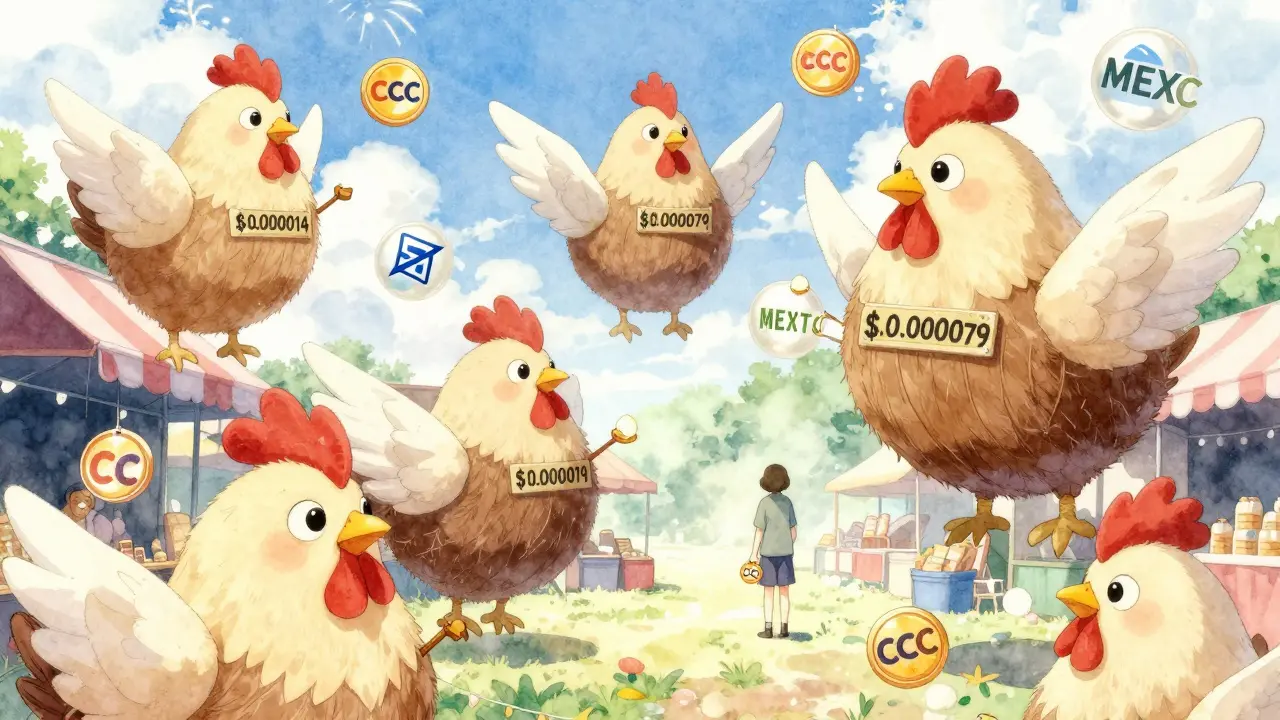
The next day, December 23, 2023, the Coconut Chicken (CCC) is a meme token built on the TRON blockchain using the Tron20 standard was launched. There was no ICO. No venture capital. No corporate backing. It was pure community-driven chaos. And that’s what makes it interesting. Unlike most crypto projects that try to sound like Wall Street, CCC leans into the absurd. It doesn’t pretend to solve anything. It’s just a digital chicken made of coconuts, floating on the TRON network.
How Many Coconut Chicken Tokens Are Out There?
The tokenomics are simple: Coconut Chicken has a maximum supply of 10 billion CCC tokens. That’s a lot. For comparison, Bitcoin’s max supply is 21 million. So why 10 billion? Because meme coins thrive on low individual token value. With billions in circulation, each coin stays cheap - often under a fraction of a cent - making it feel like you’re buying "more" even though you’re not.
As of early 2026, about 9.34 billion CCC tokens are in circulation. That means nearly 93% of the total supply is already out there. There’s no major inflation left to worry about. The supply is mostly fixed. That’s unusual for a meme coin - most keep minting new tokens. CCC didn’t. It just dropped the full supply and walked away.
What’s the Price of Coconut Chicken Right Now?
Here’s where things get messy. You won’t find one clean price for CCC. Different exchanges report wildly different numbers.
- Bybit shows it at $0.0000143
- Binance says $0.000014
- CoinCodex reports $0.00006887
- Coinbase lists $0.00007929
- CoinMarketCap says $0.0000657
Why the gap? Because CCC trades on a handful of smaller exchanges, and none of them have deep liquidity. The price swings depending on who’s buying and where. A $0.000014 price on one site and $0.000079 on another? That’s not a glitch - it’s normal for a low-cap meme coin with fragmented trading.
As of March 2026, the most consistent price range is between $0.000014 and $0.00008. That’s less than one-hundredth of a cent per token. But because there are billions of them, the total market cap still jumps around.
Market Cap and Rankings - The Numbers Don’t Lie
Market cap = price × circulating supply. Simple math. But because prices vary, so do the numbers:
| Platform | Price (USD) | Market Cap (USD) | 24h Volume (USD) |
|---|---|---|---|
| Bybit | $0.0000143 | $133,540 | $1.2M (estimated) |
| Binance | $0.000014 | $133,389 | $0 |
| CoinCodex | $0.00006887 | $643,179 | $3.46M |
| CoinGecko | $0.000035 | $331,065 | $1,276 |
| CoinMarketCap | $0.0000657 | $131,208 | $0 |
You’ll notice something odd: CoinMarketCap and Binance show $0 trading volume, but CoinCodex says $3.46 million. That’s because CCC isn’t listed on big platforms like Binance. It trades on smaller exchanges like Bybit and MEXC. So if you’re using CoinMarketCap to check its price, you’re seeing stale data. The real action is happening elsewhere.
Its global ranking? It’s all over the place. CoinMarketCap puts it at #2145. CoinCodex says #153. That’s not a mistake - it’s a reflection of how unreliable these rankings are for tiny tokens. If you’re looking for a stable metric, you won’t find one here.

What’s the Price History Like?
Coconut Chicken had its moment. On July 19, 2024, it hit an all-time high of $0.001533. That’s more than 100 times what it’s worth today. One year later, it’s down 97.7% from that peak.
Since then, it’s been a rollercoaster:
- March 2024: Hit $0.001042
- June 2025: Dropped to $0.00003509 (all-time low)
- February 2026: Touched $0.0000138 - its lowest point yet
- March 2026: Hovering around $0.000014 to $0.000079
It’s currently trading just 1% above its all-time low. That’s not a recovery - it’s clinging to life. And yet, it’s still trading. People are still buying. Why?
Why Do People Still Trade It?
Because meme coins aren’t about fundamentals. They’re about vibes.
CCC has:
- A funny name - nobody forgets "Coconut Chicken"
- A viral origin story - Justin Sun’s tweet gave it instant cult status
- A community that treats it like a game - not an investment
It’s not a project to get rich. It’s a project to have fun. Some people buy it because they think it’ll spike again. Others buy it because they like the logo. Some just want to say they owned the "Coconut Chicken" coin.
It’s also a testbed for how meme coins behave on TRON. Unlike Ethereum, TRON has low fees and fast transactions. That makes it easier for small tokens like CCC to move around without costing $50 in gas.
How Volatile Is It?
CoinCodex rates CCC as "medium volatility" at 3.00%. That’s not crazy - but it’s not calm either. For context:
- Bitcoin: ~1.5% daily volatility
- Ethereum: ~2.5%
- CCC: ~3% - higher than most major coins
That means if you hold CCC, you could wake up to a 10% gain or loss in a single day. It’s not unusual. The token’s low liquidity makes it easy for a few big buys or sells to swing the price.
Should You Buy Coconut Chicken?
Here’s the honest answer:
If you’re looking for a serious investment? No. It has no utility. No team. No product. No roadmap. It’s a meme.
If you’re looking for a gamble with a laugh? Maybe. It’s cheap. You can buy millions of tokens for $10. And if the meme culture ever rallies again - if Justin Sun tweets again, or if a viral TikTok trend picks it up - it could spike. Just don’t assume it’ll last.
Don’t invest money you can’t afford to lose. Don’t use it as a retirement strategy. Don’t compare it to Bitcoin or Solana. It’s not in the same league. It’s a digital joke with a price tag.
Where Can You Buy Coconut Chicken?
You won’t find it on Coinbase, Binance, or Kraken. It’s not listed there. But you can buy it on:
- Bybit - most active market for CCC
- MEXC - offers trading pairs and price predictions
- Gate.io - occasional listings
- BitMart - sometimes listed
To buy it:
- Sign up on one of the above exchanges
- Complete Identity Verification (Level 1 usually enough)
- Deposit TRX (TRON) or USDT
- Search for "CCC/TRX" or "CCC/USDT"
- Place a market or limit order
Don’t send ETH or BTC to buy it. You need TRON-based tokens. And never send CCC to a wallet that doesn’t support Tron20 tokens - you’ll lose them.
What’s the Future of Coconut Chicken?
It doesn’t have one.
Not in the way Bitcoin or Ethereum does. It’s not evolving. It’s not being upgraded. There’s no team working on it. It’s a snapshot of a moment - a tweet turned into a token.
Its future depends entirely on two things:
- Whether the meme culture revives it
- Whether Justin Sun mentions it again
If neither happens? It’ll keep drifting lower, inching closer to zero. If one does? It could spike overnight - and crash again by next week.
That’s the nature of meme coins. They’re not investments. They’re events. And events come and go.
Basil Bacor
March 5, 2026 AT 05:06Emily Pegg
March 5, 2026 AT 22:35Ethan Grace
March 6, 2026 AT 17:58Jamie Hoyle
March 7, 2026 AT 03:08Jeffrey Dean
March 7, 2026 AT 17:57Brian T
March 8, 2026 AT 04:19Nash Tree Service
March 8, 2026 AT 11:38Jane Darrah
March 10, 2026 AT 07:40Denise Folituu
March 10, 2026 AT 15:14jack carr
March 11, 2026 AT 20:44Eva Gupta
March 13, 2026 AT 09:54Nancy Jewer
March 13, 2026 AT 18:22Ken Kemp
March 15, 2026 AT 06:10Leah Dallaire
March 16, 2026 AT 12:38James Burke
March 17, 2026 AT 00:39Olivia Parsons
March 17, 2026 AT 04:11Nick Greening
March 17, 2026 AT 21:04Issack Vaid
March 18, 2026 AT 02:41