
Imagine holding a piece of Coinbase Global, the massive cryptocurrency exchange, but keeping it in your digital wallet instead of a traditional brokerage account. That is exactly what Coinbase tokenized stock (ticker: COINX or COINx) offers. It is not just another meme coin hoping for a viral pump. It is a sophisticated financial instrument designed to bridge the gap between Wall Street’s regulated equity markets and the wild west of decentralized finance.
If you have been hearing about "Real-World Assets" (RWAs) taking over crypto, COINX is one of the leading examples. But before you rush to buy, you need to understand that this token does not make you a shareholder in the traditional sense. It is a tracker certificate issued by Backed Finance, a Switzerland-based firm that specializes in bringing traditional securities onto the blockchain. Let’s break down how it works, where you can trade it, and whether it actually makes sense for your portfolio.
How COINX Works: The Tracker Certificate Model
To understand COINX, you first need to separate the concept from direct stock ownership. When you buy shares of Coinbase Global (NASDAQ: COIN) through a broker like Fidelity or Robinhood, you become a registered owner. You get voting rights, you receive dividends directly if declared, and you are protected by US securities laws specific to retail investors.
COINX operates differently. It is a tracker certificate. This means that for every single COINX token in circulation, there is a corresponding amount of actual Coinbase stock held in reserve by a third-party custodian. Think of it like a receipt. The receipt proves that someone holds the goods, but the receipt itself isn’t the product. According to documentation from Backed Assets and listings on platforms like Kraken, each token is backed 1:1 by real shares. However, as a holder of COINX, you do not have shareholder rights. You cannot vote in Coinbase’s annual meetings, and you don’t get dividend checks mailed to your house. Instead, the economic value of those dividends is usually reflected in the price of the token or distributed via secondary mechanisms defined by the issuer.
This structure allows the token to exist on blockchains-specifically Ethereum as an ERC-20 token and Solana as an SPL token. This dual-chain presence is crucial because it lets users interact with their equity exposure using standard crypto wallets like MetaMask or Phantom, rather than logging into a banking app.
Why Use COINX Instead of Just Buying COIN Stock?
You might be asking, "Why would I pay fees for a wrapper when I can just buy the stock?" For many traditional investors, you wouldn’t. But for crypto-native users, COINX solves several specific problems:
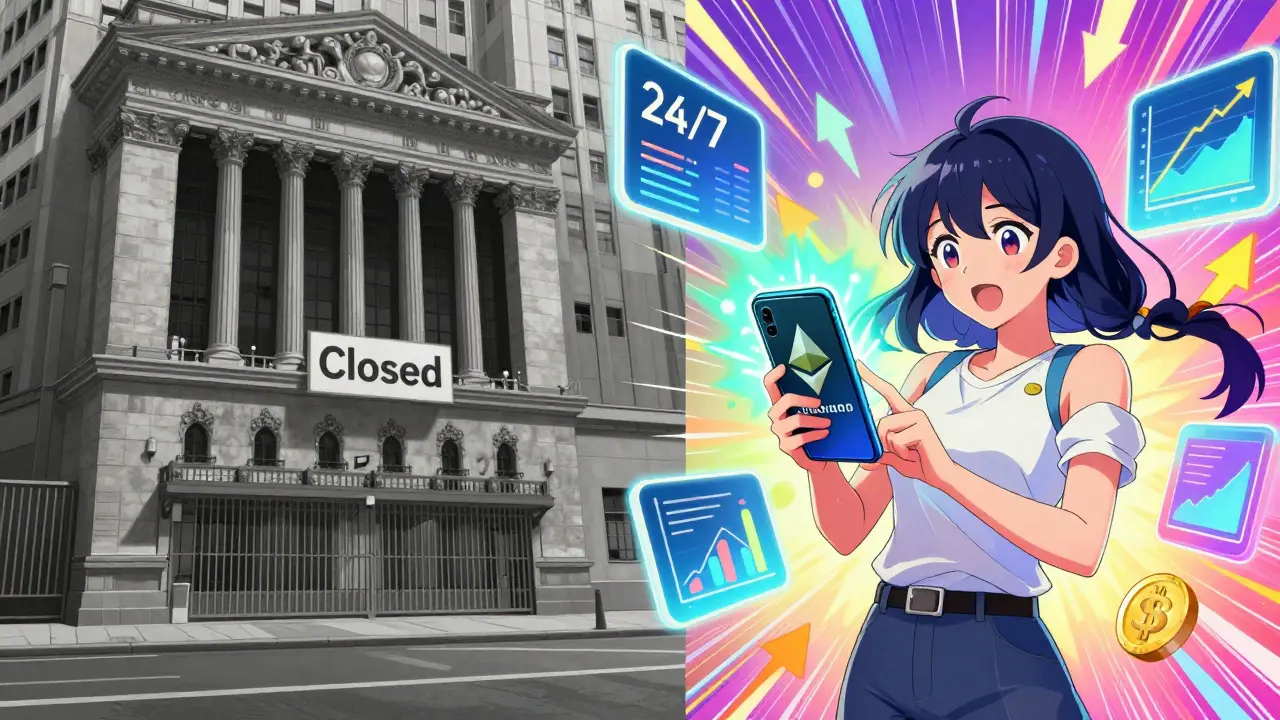
- 24/7 Trading: Traditional stock markets close at 4 PM EST. Crypto never sleeps. If big news breaks about Coinbase on a Sunday night, the NASDAQ won’t open until Monday morning. With COINX on Solana or Ethereum, you can trade your position immediately, capturing volatility that traditional brokers miss.
- Self-Custody: In DeFi, "not your keys, not your coins." While COINX relies on an issuer for the underlying asset, the token itself lives in your wallet. You control the private key, reducing reliance on a centralized exchange’s solvency for the storage of the token unit itself.
- Composability: This is the killer feature for advanced users. Because COINX is a standard token, it can potentially be used as collateral in lending protocols, swapped instantly on decentralized exchanges (DEXs), or integrated into automated trading strategies without ever leaving the blockchain ecosystem.
- Faster Settlement: Traditional stock trades take T+2 days to settle. On Solana, transactions confirm in sub-seconds. On Ethereum, they take minutes. This speed is vital for algorithmic traders and high-frequency strategies.
The Cost of Convenience: Fees and Economics
Nothing in finance is free, and COINX is no exception. Understanding the fee structure is critical to calculating your actual returns. According to Backed Assets product sheets, the current management fee is 0%. However, they reserve the right to introduce a fee of up to 0.25% per year in the future. This is relatively low compared to actively managed mutual funds, which often charge 1% or more.
More immediate costs come from entry and exit fees. Users may face transaction fees of up to 0.50% of their investment value when buying or redeeming tokens through primary channels. If you buy and sell frequently, these fees add up quickly. Furthermore, trading on secondary markets introduces additional layers of cost:
| Cost Factor | Direct COIN Stock (Broker) | COINX Token (Crypto) |
|---|---|---|
| Management Fee | $0 (for most zero-commission brokers) | 0% currently (up to 0.25% potential future fee) |
| Entry/Exit Fee | $0 (typically) | Up to 0.50% per transaction (primary market) |
| Trading Fee | Variable (often $0-$1 per trade) | Variable (DEX liquidity fees + Gas/Solana fees) |
| Settlement Time | T+2 Days | Seconds to Minutes |
| Shareholder Rights | Yes (Voting, Dividends) | No (Price tracking only) |
When trading on decentralized exchanges like Uniswap (Ethereum) or Jupiter (Solana), you also pay network gas fees. On Ethereum, during peak times, this could mean paying $5-$20 in gas just to execute a swap. On Solana, fees are fractions of a cent, making it much more efficient for smaller trades. Always factor in slippage-the difference between the expected price and the executed price-which can be significant in thin markets.
Market Data and Liquidity Realities
One of the biggest challenges with tokenized stocks is fragmented liquidity. Unlike Bitcoin, which has a unified global price, COINX prices can vary significantly depending on where you look. This is because different venues have different order books, liquidity pools, and redemption mechanics.
For example, data snapshots show discrepancies across major platforms. One source might list COINX at ~$395, while another shows it at ~$183. These differences arise from timing delays, venue-specific premiums or discounts, and varying levels of liquidity. As of mid-2026, the total supply of COINX is capped around 12,000 tokens, with roughly 6,000 in circulation. This is a tiny float compared to the hundreds of millions of actual Coinbase shares outstanding. Consequently, large institutional orders could easily move the price, causing significant slippage.
Market capitalization figures also vary wildly depending on the aggregator. Some sources report a market cap near $2.3 million, while others, reflecting broader secondary trading volume, suggest values closer to $48 million. This fragmentation means you must check multiple sources-such as CoinMarketCap, Crypto.com, and Kraken-to get a true sense of fair value. If you see a huge price difference between Kraken’s COINx listing and the Ethereum DEX price, arbitrage opportunities may exist, but so do execution risks.
Risks You Cannot Ignore
While the technology behind COINX is robust, the risks are substantial and distinct from holding regular crypto or stocks.
- Counterparty Risk: You are trusting Backed Finance and its custodians to hold the underlying Coinbase shares. If the issuer goes bankrupt, faces regulatory seizure, or suffers a cyberattack, your tokens could lose value regardless of what happens to Coinbase’s stock price. This is similar to the risk faced by holders of stablecoins if the issuer fails to maintain reserves.
- Regulatory Uncertainty: Tokenized securities operate in a gray area globally. Backed Finance restricts primary issuance to eligible investors outside prohibited jurisdictions, notably excluding U.S. persons due to SEC regulations. This limits the pool of buyers and can create liquidity crunches. If regulators crack down harder on tokenized equities, access could be restricted further.
- Liquidity Risk: With a small circulating supply, exiting a large position can be difficult. You might find yourself unable to sell your COINX at the fair market price because there aren’t enough buyers on the DEX or CEX at that moment.
- Smart Contract Risk: Although Backed uses audited contracts, any code on Ethereum or Solana carries inherent risk. A bug in the token contract or an exploit in a connected DeFi protocol could lead to loss of funds.
Who Is COINX For?
COINX is not a one-size-fits-all solution. It is best suited for crypto-native investors who already use self-custody wallets and want to diversify their portfolio with traditional equity exposure without moving funds back to a bank. It appeals to traders who want to capitalize on after-hours volatility or integrate equity positions into complex DeFi strategies.
However, if you are a long-term investor looking for voting rights, direct dividend payments, and maximum regulatory protection, buying actual Coinbase stock through a licensed broker remains the superior choice. COINX is a tool for efficiency and integration within the crypto ecosystem, not a replacement for traditional investing for everyone.
How to Get Started
If you decide COINX fits your strategy, here is the practical path forward:
- Choose Your Chain: Decide if you want to use Ethereum (higher security, higher fees) or Solana (lower fees, faster speeds). Most retail traders prefer Solana for lower overhead.
- Select a Venue: For secondary market purchases, look at centralized exchanges like Kraken which list COINx, or decentralized exchanges like Jupiter (Solana) or Uniswap (Ethereum).
- Verify Authenticity: Always double-check the contract address. Scammers often create fake tokens with similar tickers. Official addresses are listed on Backed Finance's official site and verified aggregators like CoinMarketCap.
- Execute the Trade: Swap your stablecoin (USDC/USDT) for COINX. Be mindful of slippage settings; set them tight to avoid bad deals in thin liquidity pools.
- Store Safely: Keep your tokens in a secure hardware wallet like Ledger or Trezor if holding long-term, ensuring the wallet supports the specific chain (ERC-20 or SPL).
Is COINX the same as Coinbase stock (COIN)?
No. COIN is the actual Class A common stock traded on NASDAQ, granting shareholder rights like voting. COINX is a tokenized tracker certificate that mirrors the price of COIN but does not grant ownership or voting rights. It is a derivative product issued by Backed Finance.
Can US residents buy COINX?
Primary issuance of COINX by Backed Finance is generally restricted to non-US residents due to securities regulations. However, US residents may sometimes find COINX on secondary markets like certain DEXs or CEXs, though this depends on the specific platform's compliance policies and geo-blocking measures.
Does COINX pay dividends?
Not in the traditional sense. Since COINX holders are not shareholders, they do not receive direct dividend payments from Coinbase. Any value from dividends is typically absorbed into the token's net asset value or handled according to Backed Finance's specific distribution terms, which may involve periodic adjustments rather than direct payouts.
Which blockchain is better for COINX: Ethereum or Solana?
It depends on your priority. Ethereum offers deeper institutional liquidity and higher security assurance but comes with high gas fees. Solana offers near-instant settlement and negligible transaction fees, making it more cost-effective for frequent trading and smaller positions. Both versions represent the same underlying asset.
What happens if Backed Finance goes bankrupt?
This is the primary counterparty risk. While the underlying shares are held by a third-party custodian, the legal structure of the tracker certificate means you rely on Backed Finance's operational integrity. If the issuer fails, redemption processes could be delayed or halted, potentially causing the token's market price to drop significantly below the value of the underlying stock.