

Imagine running a full Bitcoin node on your smartphone. It sounds impossible, right? Bitcoin nodes require significant storage and processing power, usually demanding dedicated servers or powerful desktop computers. But what if you could hold the entire ledger of a blockchain network in your pocket, validating every transaction yourself without relying on a centralized server or a "light" wallet that trusts strangers?
This is the core promise of Minima, a Layer 1 blockchain designed for the edge. Unlike most cryptocurrencies that force users into a hierarchy where only wealthy miners or stakers validate transactions, Minima aims for true sovereignty at the edge. Every user, from a person with an old Android phone to an industrial IoT sensor, runs a full node. This means everyone has equal power, security, and responsibility in the network.
The Problem with Current Blockchains
To understand why Minima exists, we have to look at how traditional blockchains like Bitcoin and the original decentralized digital currency launched in 2009 and Ethereum and a programmable blockchain platform launched in 2015 work today. Over the years, these networks have grown massive. The Bitcoin blockchain alone is hundreds of gigabytes in size. Running a full node requires constant internet connection, large hard drives, and electricity costs that many casual users aren't willing to pay.
As a result, most people use "light clients." These are wallets that don't download the whole blockchain. Instead, they ask a third-party server (like an exchange or a public RPC node) to tell them their balance and confirm transactions. You are essentially trusting someone else’s word. If that server goes down, lies, or gets hacked, you lose control. This centralization risk contradicts the very idea of decentralization.
Minima was founded in 2018 by CEO Hugo Feiler and CTO Paddy Cerri to solve this. They asked: What if we built a blockchain so lightweight that it fits on any device? The answer is Minima, a protocol optimized for mobile phones and Internet of Things (IoT) devices.
How Minima Works: Tx-PoW Consensus
The secret sauce behind Minima’s efficiency is its unique consensus mechanism called Transaction-based Proof of Work (Tx-PoW). Unlike Bitcoin's block-centric mining, Tx-PoW allows individual transactions to carry proof-of-work.
In standard Proof of Work (PoW), miners compete to solve complex puzzles to create a new block containing many transactions. In Minima’s Tx-PoW model, users mine their own transactions. When you send a MINIMA coin, your device does a small amount of computational work to "sign" that transaction with proof-of-work. This work contributes to the overall security and ordering of the chain.
Here is why this matters:
- No Specialized Miners Needed: You don’t need expensive ASIC machines. Your phone’s processor is enough to mine your own transaction fees.
- Decentralized Validation: Since every user runs a full node, everyone validates every transaction. There is no single point of failure.
- Censorship Resistance: Because there is no central validator set, it is incredibly difficult for any group to censor specific transactions.
This approach keeps the blockchain state compressed and small. While Bitcoin’s blockchain grows indefinitely, Minima uses techniques to keep the data footprint manageable for low-storage devices. This allows a smartphone to store the entire history of the network and verify every transaction from day one.
Tokenomics: Supply and Distribution
Understanding the economics of MINIMA is crucial for investors and users alike. The total supply of MINIMA is fixed at 1,000,000,000 coins. There are no new coins being minted through inflationary block rewards. All coins were created during the Token Generation Event (TGE).
The distribution is split into two main categories:
- Native MINIMA: Approximately 875,000,000 coins exist as native tokens on the Minima blockchain. These are used for peer-to-peer payments, paying transaction fees, and interacting with MiniDapps (decentralized applications) within the ecosystem.
- Wrapped Minima (WMINIMA): About 125,000,000 coins (12.5% of the supply) were issued as ERC-20 tokens on the Ethereum network. This wrapped version allows early trading on centralized exchanges that support Ethereum assets but not yet native Minima integrations.
Users holding WMINIMA can swap it for native MINIMA using the MiniSwap MiniDapp. As more exchanges integrate directly with the Minima mainnet, the liquidity is expected to shift toward the native coin, reducing reliance on the wrapped version.
| Feature | Bitcoin / Ethereum | Minima (MINIMA) |
|---|---|---|
| Node Requirement | Powerful hardware, high storage | Any smartphone or IoT device |
| Consensus Model | Block-based PoW or PoS | Transaction-based PoW (Tx-PoW) |
| User Role | Light client (trusts others) or Miner/Staker | Full Node Validator (sovereign) |
| Primary Use Case | Digital Gold, Smart Contracts | IoT, Machine-to-Machine Payments, Edge Computing |
| Total Supply | 21M BTC (inflationary until cap) / Unlimited ETH | 1 Billion MINIMA (fixed) |
Use Cases: Beyond Human Wallets
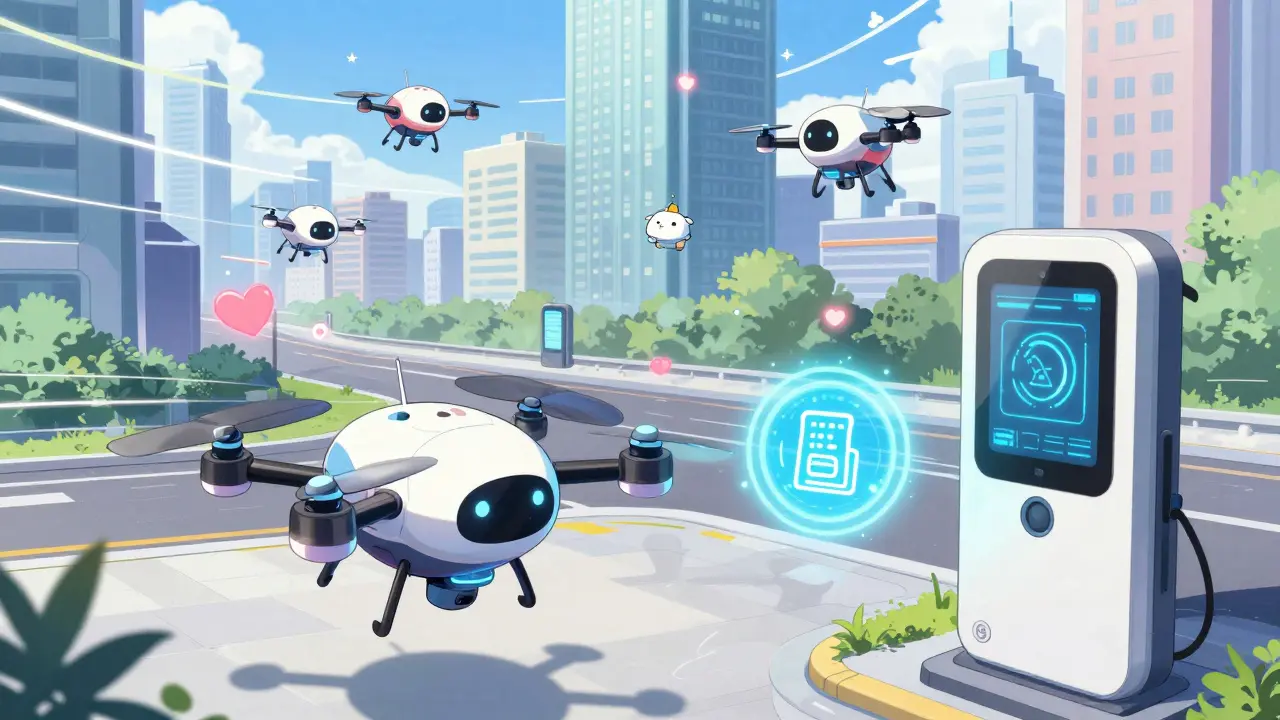
While you can use Minima to send money to friends, its real potential lies in the Internet of Things (IoT). Imagine a fleet of delivery drones. Currently, these drones rely on cloud servers to coordinate routes and payments. If the server goes down, the drones stop. With Minima, each drone can run a full node. They can verify transactions, share data, and even pay for charging station services autonomously, without human intervention or central oversight.
Other potential applications include:
- Secure Messaging: Using the blockchain to notarize messages, ensuring they haven't been tampered with.
- Supply Chain Tracking: Small sensors on shipping containers recording temperature and location data directly to the immutable ledger.
- Microtransactions: Enabling tiny payments between devices, such as a smart car paying a toll booth automatically.
The concept of "autonomous agents" is central here. Minima provides the infrastructure for AI bots and machines to interact economically in a trustless environment.

How to Get Started with Minima
If you want to experience Minima firsthand, you don’t need to buy a GPU rig. Here is how you can participate:
- Download the App: Install the Minima app on your Android or iOS device. This installs a full node on your phone.
- Sync the Chain: Wait for your device to sync with the network. Because the blockchain is small, this happens relatively quickly compared to Bitcoin.
- Acquire MINIMA: You can buy Wrapped Minima (WMINIMA) on supported centralized exchanges like Bitfinex, then swap it for native MINIMA using the MiniSwap interface within the app. Alternatively, wait for direct listings on other exchanges.
- Mine Transactions: When you send MINIMA, your phone will automatically perform the Tx-PoW calculation. You are now contributing to the network’s security.
Note that because Minima is still growing its ecosystem, liquidity might be lower than major coins like Bitcoin or Ethereum. Always check current exchange listings and fees before trading.
Risks and Challenges
No technology is perfect, and Minima faces several hurdles. First, the ecosystem is young. Compared to Ethereum’s thousands of decentralized apps, Minima’s library of MiniDapps is still developing. Developers need to learn a new scripting language, which slows adoption.
Second, while mobile nodes are convenient, they are not always online. If your phone turns off, your node goes offline. The network relies on a large number of participants to remain resilient. If too few people run nodes, the network becomes vulnerable to attacks. Minima addresses this by encouraging widespread adoption and making node operation as passive as possible.
Finally, regulatory uncertainty remains a factor for all cryptocurrencies. As governments clarify rules around digital assets, projects like Minima must ensure compliance while maintaining their decentralized ethos.
Is Minima a good investment?
Like all cryptocurrencies, MINIMA carries significant risk. Its value depends on adoption, technological success, and market sentiment. While its fixed supply and innovative tech offer long-term potential, it is currently a small-cap asset with higher volatility than established coins. Always do your own research and never invest more than you can afford to lose.
Can I mine MINIMA on my computer?
Yes, you can run a Minima node on Windows, macOS, Linux, or Raspberry Pi. However, the design intent is for mobile and IoT devices. Mining on a computer works similarly to mobile, using the Tx-PoW method to secure your own transactions rather than competing in large-scale block mining.
What is the difference between MINIMA and WMINIMA?
MINIMA is the native token on the Minima blockchain. WMINIMA is a wrapped version of the token on the Ethereum network (ERC-20). WMINIMA allows trading on exchanges that support Ethereum but not yet Minima directly. You can swap WMINIMA for native MINIMA 1:1 using the MiniSwap dApp.
Is Minima faster than Bitcoin?
Minima aims for efficiency rather than raw speed. Transaction confirmation times depend on the difficulty settings and network load. While it may not match the throughput of high-frequency chains like Solana, its focus is on decentralization and accessibility, allowing instant validation by any user without waiting for a specialized miner.
Who founded Minima?
Minima was founded in 2018 by Hugo Feiler (CEO) and Paddy Cerri (CTO). The company is headquartered in Zug, Switzerland, and London, UK. Their goal was to create a blockchain infrastructure that enables sovereignty at the edge for autonomous devices.